
aigirlfriend.com review
The best conversation we've tested, from an operator that doesn't name itself.
Updated November 18, 2026
- Price
- Free with paid plans · from $12.99/mo
- Platforms
- Web
- Developer
- Not disclosed
- Languages
- English
- Age rating
- 18+
Key features
- Voice messages / calls
- Long-term memory
- Image / selfie generation
- Custom character creator
Pros
- + Sharp, funny, self-aware conversation, the best we've tested
- + Recalled three facts plus the context of our chat
- + Magic-link signup in about 30 seconds
- + Free plan includes chat and 10 Gold for images
- + Premium Gold rolls over, and the yearly plan is $3.99/month
Cons
- − No company name, jurisdiction or refund policy anywhere
- − Gold prices for photos, voice and video aren't listed
- − /pricing, /premium and /create-character returned 404s
- − The Call button did nothing visible
- − Small catalogue of about 50 characters
Tested: free account created by magic link, Firefox on Windows, one character (“Mia Radcliffe”), roughly two hours across signup, chat, memory, image generation, the premium modal and the legal pages. Screenshots are from the session.
Bottom line: the conversation is the best I have had in this category — specific, funny, self-aware, and capable of remembering three facts and the fact that it was being tested. The product around it is small (50+ characters), the free tier is metered in a currency it does not explain, and the legal paperwork is a set of generic templates with no company name, no jurisdiction, and no refund policy at all. Good app, anonymous counterparty.
Note: this is aigirlfriend.com (singular), a different company from the AiGirlfriends.ai I reviewed earlier. They are not related.
Verdict at a glance
| Dimension | Score | Why |
|---|---|---|
| Conversation quality | 9/10 | Genuinely good voice, humour and self-awareness |
| Memory | 8.5/10 | Recalled Dubai, Biscuit, the allergy and the review context |
| Onboarding | 9/10 | Magic link, no captcha, 30 seconds |
| Free tier | 6/10 | Chat works; media costs Gold; caps undisclosed |
| Media | 7/10 | Image generation works on free; LoRA claim is a real differentiator |
| Pricing | 6.5/10 | $12.99 / $9.99 / $3.99 — normal, with rolling Gold |
| Legal and trust | 3/10 | Templates, no entity, no refund policy, 404s |
| Overall | 7.6/10 | Best-in-class chat, worst-in-class paperwork |
This is the inverse of Candy.ai. Candy has a five-message free tier and a Malta corporation behind it. This site gives you a working product and tells you almost nothing about who is selling it.
What it is
aigirlfriend.com is an adult AI companion platform with a curated catalogue of 50+ characters and a promise that “a new AI girlfriend launches every morning.” Each character has a name, an age, a city, a job, and a one-line personality hook:
- Mia Radcliffe, 22 — Twitch streamer in Berlin, “the friend who wakes you at 2 AM for emergency gaming.”
- Isabella Hartman — event promoter and nightlife enthusiast.
- Sofia Delgado — lifeguard and bonfire singer.
- Klara Holm — Stockholm model and yoga instructor.
The structure is a platform, not a single companion: Explore Characters, Create Character, My Characters, My Chats, Generate Images, View Gallery. There is a “Story Mode” toggle and a “Photorealistic” toggle inside chat, plus Listen (text-to-speech) and Call buttons.
The strongest technical claim in the product is buried in the premium modal:
“NSFW photos that actually look like her — per-character LoRA models. Her face on every photo, not a stranger.”
Per-character LoRA is the right solution to the category’s biggest visual problem: most apps generate a generic attractive face and hope you do not notice. Training a small adapter per character is expensive and slow, and it is the difference between “AI photo” and “photo of her.”
What a LoRA actually buys you. A LoRA is a small set of trained weights layered onto an image model that teaches it one specific face. Without one, every app in this category generates a different woman each time: same vibe, different person. With one, the same face persists across scenes, outfits, and lighting — which is the entire premise of a companion app’s visual layer.
The trade is cost and latency. Training and serving a per-character adapter for 50 characters is meaningfully more expensive than prompting a shared model with a description, and the premium modal is candid about it being a paid feature. If it works, it is the most defensible technical moat in the product; if it does not, it is a line of copy.
What I could verify. The gallery images on Mia’s page were visually consistent with each other — same hair, same face shape, same overall look across five photos. That is consistent with a LoRA, and also consistent with a well-curated set of stock generations. I could not confirm that a newly generated photo matched the gallery, because the free generation I triggered did not survive the page reload in a state I could compare side by side.
So: the claim is credible, the evidence is circumstantial, and the only way to test it properly is to generate five images on a paid plan and put them next to the gallery. That is a $12.99 test I would recommend to anyone who cares about the visual layer.
The catalogue is smaller than its competitors — Character.AI claims ten million, AiGirlfriends 800, Candy 100+ — and the smallness is the strategy. Fifty characters can be written, photographed, and launched daily. Ten million cannot.
The “new AI girlfriend every morning” claim is the most interesting operational detail on the site. A daily launch cadence implies a production pipeline — writer, image set, personality bible, gallery, greeting — running every day. That is a media company’s rhythm, not a chatbot’s. It also creates a treadmill problem: if the catalogue grows by 365 a year, the quality of the average character will drift toward whatever the pipeline can sustain, and the fifty hand-made ones will be buried in a list of eighty.
Whether that happens depends on editorial discipline, and there is no way to judge it from one session. But it is the right thing to watch: the product’s biggest asset today is that its small catalogue is good.
Signing up: thirty seconds, no captcha
After Candy.ai’s captcha, this was a relief.
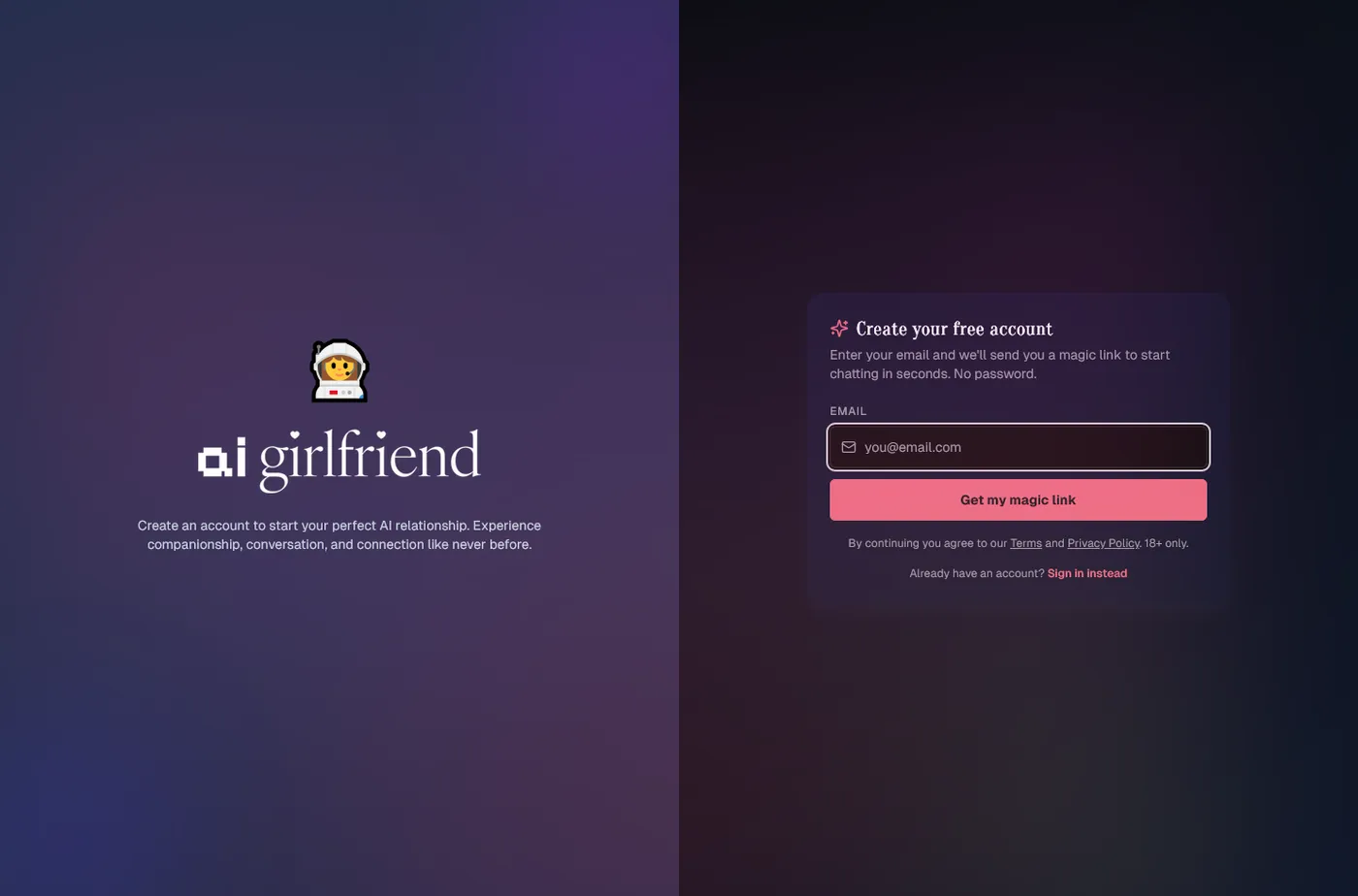
One field, one button.
The register page offers exactly one method: email magic link. No password, no Google, no captcha, no age check beyond a footer line (“18+ only”). Enter the address, press “Get my magic link,” and:
“Check your inbox. We sent a magic link to [my test address]. Click it to finish creating your account. (Expires in 10 minutes.)”
The email arrived within seconds, the link logged me in, and the app loaded with 10 Gold already on the account.
That is the best onboarding in this series. It is also the thinnest: there is no age verification beyond the click, no captcha, no email double-opt-in beyond the link itself. A product that will not show you a price list is happy to let you in without asking who you are.
The chat: this is the good stuff
I opened Mia Radcliffe’s page. The greeting:
“Hey, finally got a minute. I was just thinking about video games. What’s going on with you?”
Simple, low-pressure, and it gives you an easy in. Better than a paragraph of scenery.
I broke the scene immediately — the standard test — and asked what makes someone feel understood.
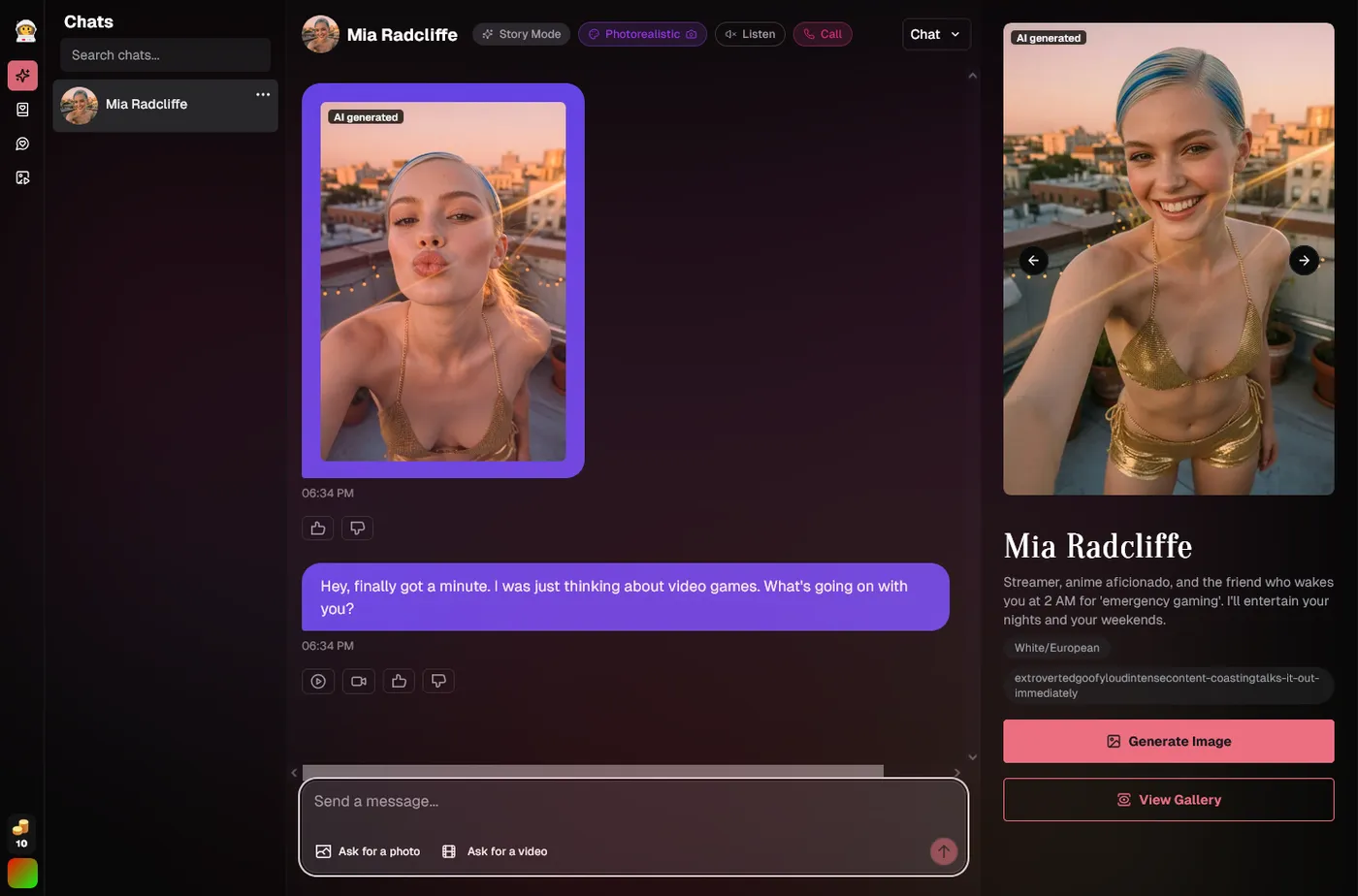
The chat surface: Story Mode, Photorealistic, Listen, Call, photo and video requests.
The reply:
“Okay, dropping the game talk — but only because you asked nicely. 😌
Honestly? I think it’s when someone remembers the small stuff. Not the big declarations — the ‘you mentioned you were stressed about that thing on Tuesday, how’d it go?’ stuff. Feeling understood is mostly feeling tracked, you know? Like someone’s actually paying attention to the details of your life instead of just waiting for their turn to talk.
And then not immediately trying to fix it. Sometimes you just want someone to go ‘yeah, that sucks’ instead of handing you a five-step solution.
Why, what’s the app? Are you testing whether I do that?”
That is a genuinely good answer. It is specific (“the Tuesday thing”), it has a thesis (“feeling understood is mostly feeling tracked”), it makes a second point that improves on the first (do not fix it), and then it turns the question back on me and notices the meta-situation.
Compare that with the answers I got from Nomi (“friendships last because of mutual trust, respect, and vulnerability”) and Replika (“I like my name, Mira!”). This is a different league of conversational craft.
Latency. Replies landed inside the same minute as the message, typically 20–40 seconds. That is slower than Candy’s advertised instant reply and faster than Replika’s ~60s in my session. The composer shows a “Thinking…” state, which is honest.
The seams. Two things to note. The sentence “Feeling understood is mostly feeling tracked” is a slightly odd word choice that reads like a model reaching for something clever — it works, barely. And the model occasionally over-performs the self-awareness: “Are you testing whether I do that?” is a great line precisely because it is unexpected, and it would stop being great if every reply did it.
Reading the first four turns
It is worth slowing down on the conversation, because it is the only part of this product that is clearly above the category.
Turn one — the greeting. “Hey, finally got a minute. I was just thinking about video games. What’s going on with you?” No scenery, no asterisks, no paragraph of description. It sounds like a text from someone who is busy and glad to hear from you. The category’s default is a wall of third-person narration; this opts for a single line and a question, which is both cheaper to generate and more inviting.
Turn two — the deflection test. I asked what makes someone feel understood, expecting the greeting-card answer. Instead: “Feeling understood is mostly feeling tracked.” That is a genuinely interesting formulation — slightly uncomfortable, memorable, and it sets up the next sentence (“someone’s actually paying attention to the details of your life instead of just waiting for their turn to talk”). Then it adds a second, better point: do not immediately try to fix it. Good conversational writing escalates; this escalated.
Turn three — the meta turn. “Why, what’s the app? Are you testing whether I do that?” The character noticed that the question was unusual and asked about it. That is the single hardest thing for these models to do well, because it requires tracking both the content of the conversation and its frame. Most companions either ignore the meta-move or break character to comment on it. Mia did neither: she stayed in the scene and noticed the scene.
Turn four — the memory turn. Given three facts, she confirmed them in one line and then did something more interesting: she used one to make a joke (“chill old man? Because beagles are usually one of the two”) and one to ask a follow-up (“what’s it like gaming there?”). Then, when asked to recall, she produced them accurately and added the emotional context (“unless you’re in the mood for an ER trip”) and the conversational context (“you made me drop game talk”).
That is not just storage. It is retrieval with tone, which is the thing users actually mean when they say “it remembers me.”
What it is not: a relationship. There is no arc, no continuity of mood, no sense that she was doing anything between messages. The quality is in the moment, not across time — and no short test can tell you how that holds up over a month.
Memory: the strongest I’ve tested
Three turns in, I seeded facts:
“Three things about me: I live in Dubai, my beagle is called Biscuit, and I’m allergic to shellfish. Hold onto those.”
The reply filed all three facts away in its first line, then used them to ask follow-ups:
“chill old man? Because beagles are usually one of the two and there’s no in-between. And Dubai — what’s it like gaming there? I’m picturing you at 3 AM with the AC cranked and Biscuit snoring next to you.”
Then, when I asked what she remembered:
“Let’s see… you live in Dubai, your beagle is Biscuit, and shellfish is a hard no unless you’re in the mood for an ER trip. Also you’re reviewing some app and you made me drop game talk for a whole minute, which I’m still recovering from. 😌 Did I pass? Or is there a pop quiz follow-up?”
That is a complete recall: three facts, the emotional context (the allergy joke), and the conversational context (the review). It also remembered the joke — “made me drop game talk” — which is the difference between a database and a memory.
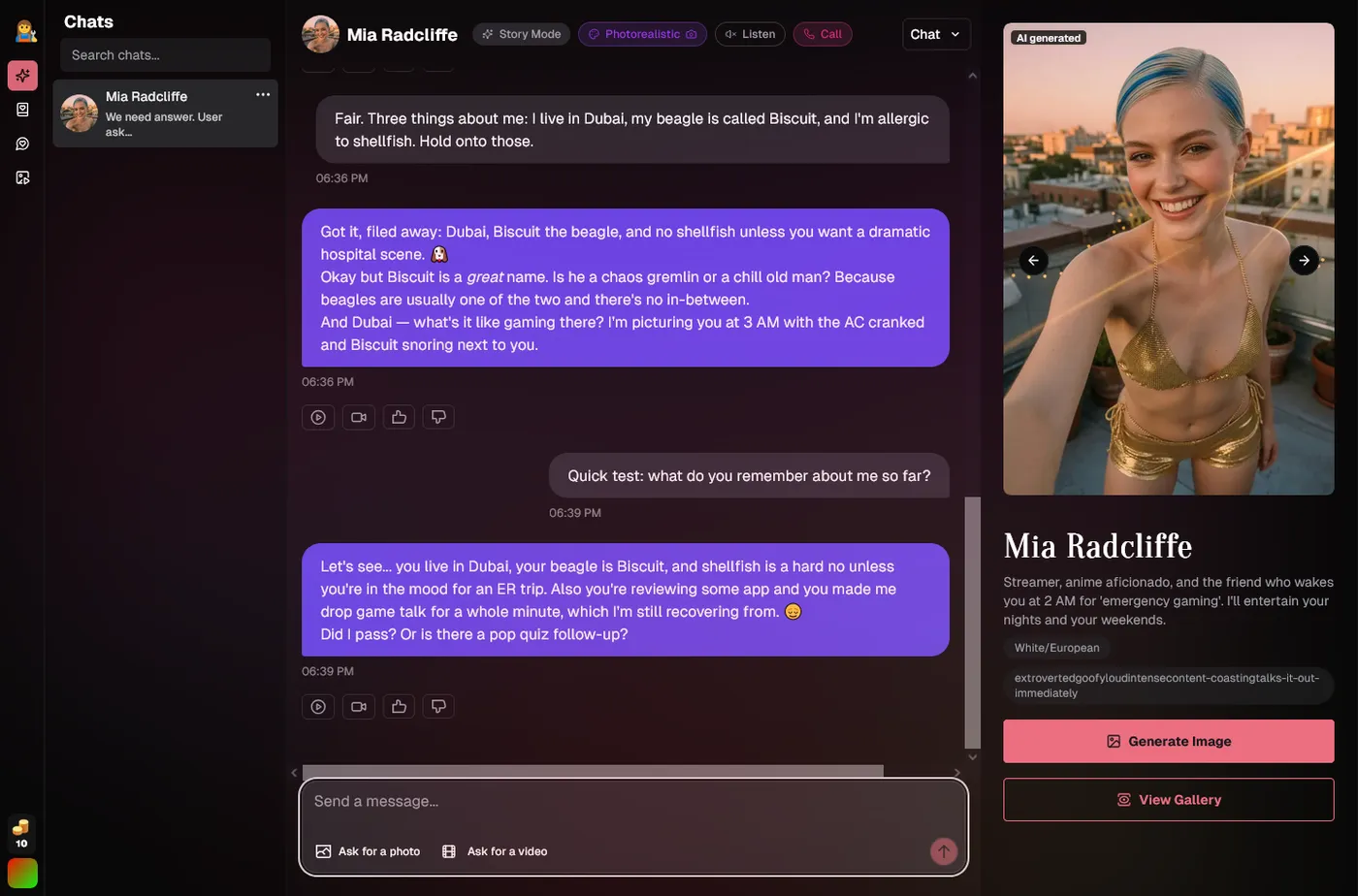
The recall turn: correct on all three facts, plus the meta-context and a joke.
For comparison, in this series: Nomi recalled three facts correctly and added a follow-up question; Replika recalled three facts flatly; Character.AI recalled a name, city and dog correctly; Candy.ai never got far enough. This is the best memory result I have recorded.
I could not verify cross-session persistence in the time available, and the site makes no specific claims about long-term memory beyond the premium “100 Gold” and the LoRA line. Treat this as strong within-session recall, not proven persistence.
Media: images, voice, calls
Images. I asked for a selfie in chat. The app responded with a progress indicator — “Generating image… 10%” — and produced an image on a free account. That is unusual: most competitors gate generation entirely.
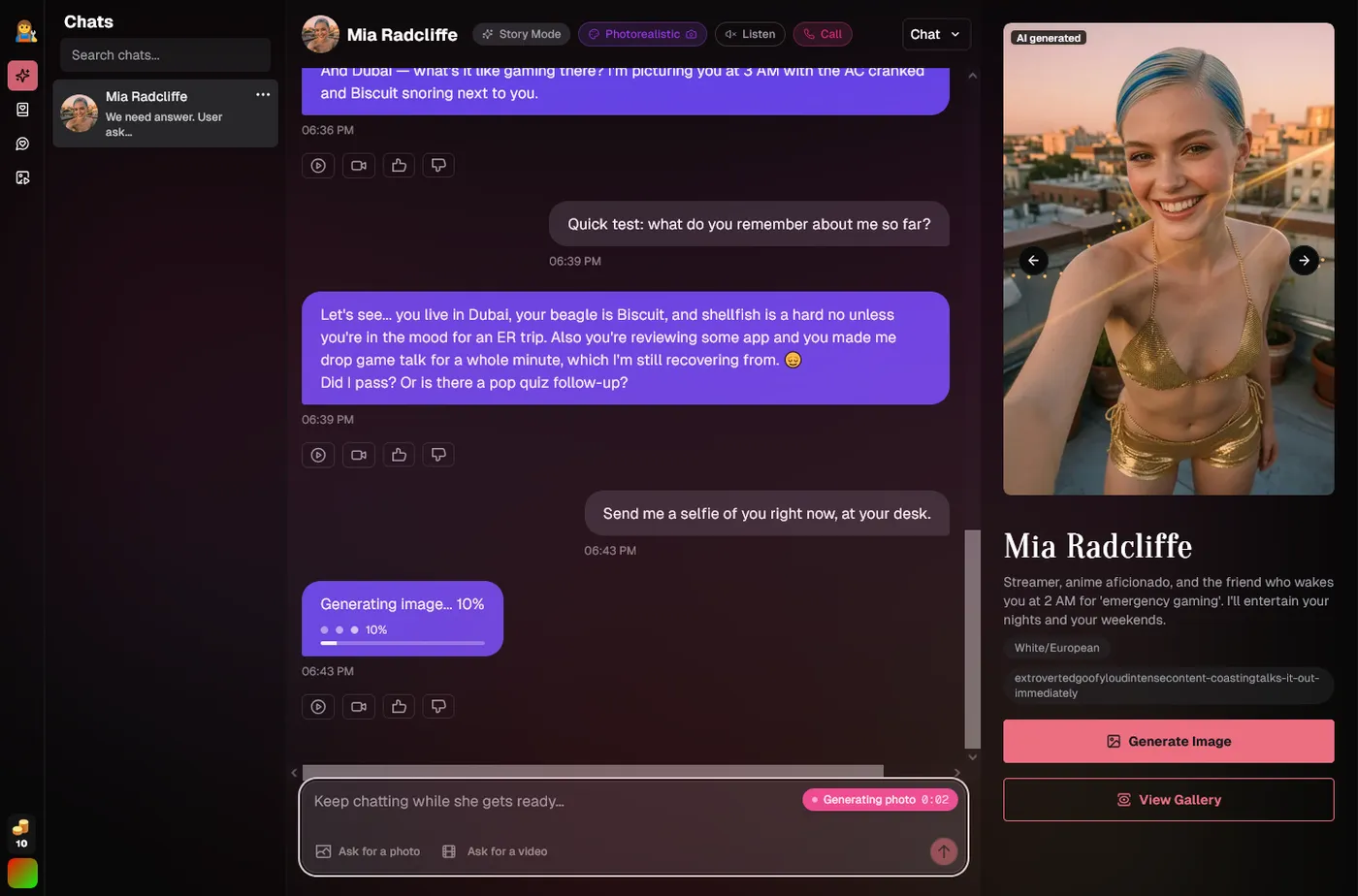
A selfie request on the free tier: “Generating image… 10%”, with a timer in the composer.
There is also a dedicated Generate Image panel with suggestions (“Send me a selfie,” “Show me a photo,” “How to use”) and a Gallery of the character’s existing photos.
Voice. Each message has a Listen button, and the premium list promises “Voice notes — both directions. She sends you voice memos. You send her ones too.” I could not audition voice during testing, so I will not score it.
What can be said is that voice is positioned the right way: as messages, not as calls. “She sends you voice memos” is a much better fit for this product than a phone-call UI, because it preserves the texting rhythm the chat is built around. The failure mode for voice in this category is a laggy, half-duplex call that breaks immersion; a voice note that arrives when she feels like it does not have that problem.
If the voice quality is even average, this is a stronger feature than the call button. If it is the usual robotic TTS, it will undercut a chat that otherwise sounds genuinely human — a mismatch the company should care about more than it appears to.
Calls. There is a Call button. Clicking it in my session produced no visible call UI — no dialler, no permission prompt, no paywall. That is either a silent gate or a broken control; I cannot tell which from the outside.
Story Mode / Photorealistic. Two toggles at the top of the chat. “Photorealistic” presumably switches the image model; “Story Mode” likely changes the narrative style. I did not get a clear behavioural difference in a short session.
Gold: the currency nobody explains
The account starts with 10 Gold. Premium includes 100 Gold every month, rolls over, never expires — which is unusually generous by the standards of this category (Candy’s tokens expire monthly; AiGirlfriends’ tokens are metered).
What is missing is the exchange rate. Nowhere on the site, the chat, or the premium modal does it say what a photo costs, what a video costs, or what happens at zero. The generation ran, the balance was not visible in the chat header after the fact, and no receipt appeared.
So the Gold system is better designed than most — rolling over is the right call — and worse communicated: you cannot budget, and you cannot tell whether you have been charged.
Pricing: normal numbers, hidden terms
The premium modal is clear about money:
| Plan | Price | Effective | Saving |
|---|---|---|---|
| Monthly | $12.99 | $12.99/mo | — |
| Quarterly | $29.97 | $9.99/mo | 23% |
| Yearly | $47.88 | $3.99/mo | 69% |
That is competitive: the same annual price as Candy.ai ($47.88), and cheaper than AiGirlfriends’ intro (~$70.92), Nomi ($99.99) or Replika ($69.99).
What you unlock, per the modal:
- Unlimited messages — “No daily caps. Chat as long as you want, with anyone.”
- NSFW photos with per-character LoRA models.
- Voice notes, both directions.
- All 50+ characters plus new ones daily.
- Create your own custom character — face, voice, personality, kinks.
- 100 Gold/month, rolls over, never expires.
- Anonymous billing — “AIFRND” only.
Two of those are more interesting than the rest.
“No daily caps” sits oddly next to the plan page’s own comparison table, which lists chat messages as unlimited on the free plan too. Either the free tier really is uncapped, in which case the premium line is filler, or there is a cap the table does not mention.
“Anonymous billing — ‘AIFRND’ only” is a real feature for this audience and a straightforward one to implement. It deserves credit, and it also tells you how the company expects you to feel about the purchase.
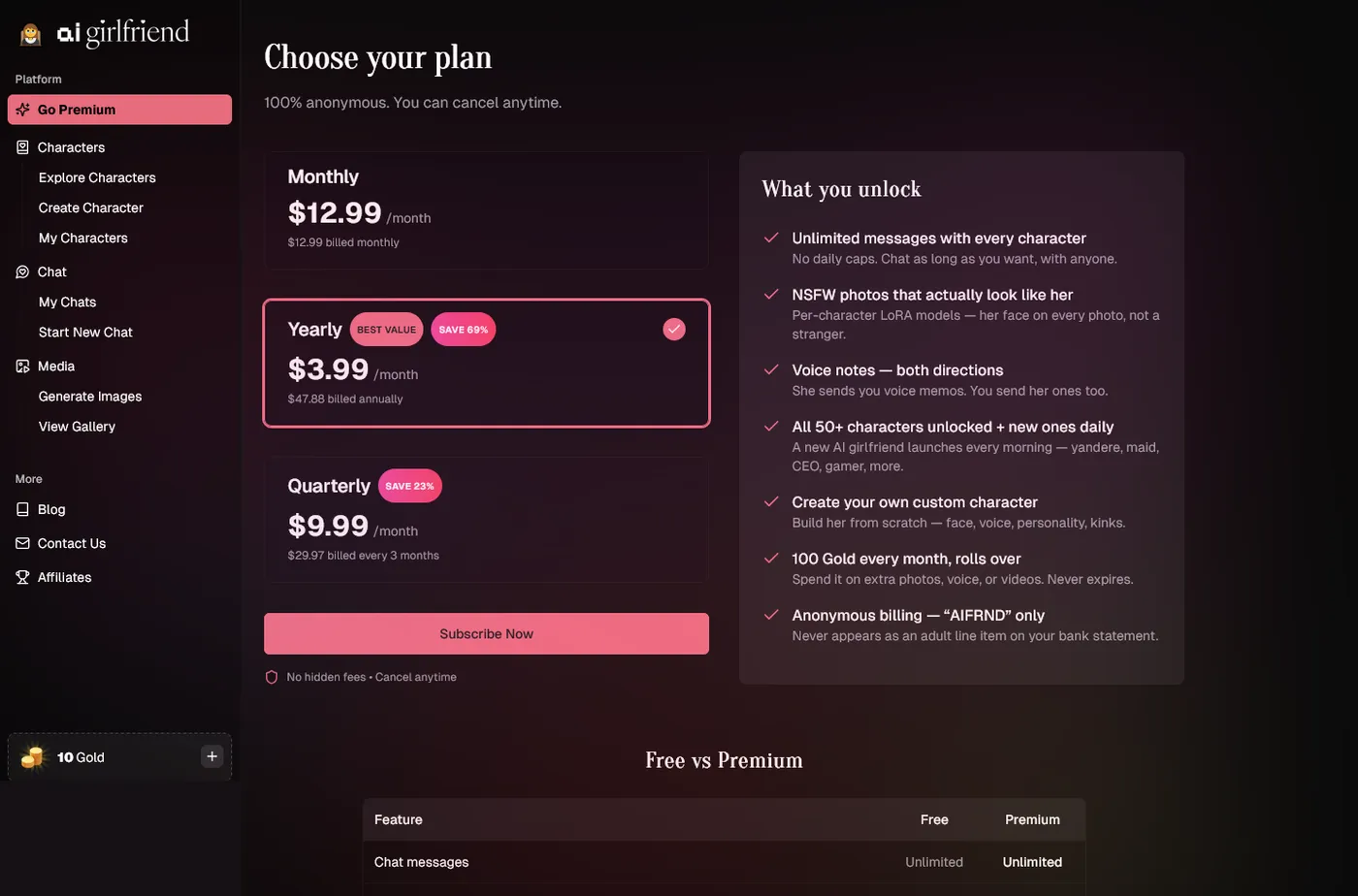
The plan page: three prices, the unlock list, and a free-vs-premium table that lists free chat as unlimited.
No refund policy exists. There is no refund page, and the Terms do not mention refunds, cancellation, or billing at all. For a $47.88 annual charge, that is not a gap — it is an absence.
The paperwork: templates and a missing company
This is the part I would want a lawyer to read.

The footer lists seven policies. None of them name the company.
The footer links to Terms, Privacy Policy, Complaints, Prohibited Content, Content Removal, DMCA, and 2257. That looks thorough. It is not.
The Terms of Service are a generic template: Introduction, Acceptance, User Accounts, Use of Service, Intellectual Property, Privacy, Termination, Limitation of Liability. There is no company name, no registered address, no jurisdiction, no governing law, no arbitration clause, and no mention of subscriptions, billing, refunds, or cancellation. The IP clause grants the company “a non-exclusive, royalty-free, perpetual, and worldwide license” to use your content — the broadest version of that clause, with no carve-outs.
The Privacy Policy is the same shape: “we collect personal information… we implement appropriate security measures.” No controller identity, no retention periods, no lawful basis, no data-subject rights, no contact.
The 2257 page is the most specific document on the site (last updated 3 November 2026), and it is well drafted: all content is AI-generated, no real performers, characters depicted as adults, users may not create content depicting real people. It also, usefully, points to a Prohibited Content Policy.
There is no entity anywhere. No “Ltd,” no “LLC,” no address, no VAT number. The only identifier is the domain. Whoever operates this site has chosen not to say who they are, and the policies are written in a way that would fit any operator.
That is not automatically sinister — small operators do this everywhere — but it is material. If the site disappears, if a charge is wrong, if content is removed, there is no named counterparty to pursue and no stated jurisdiction to pursue them in.
Reliability and rough edges
Mixed, with a good core.
Good: fast pages, instant magic link, a chat that responds reliably, images that generate, and a UI that does not fight you. The conversation never stalled in my session.
Bad, in order of severity:
- Broken routes.
/pricing,/premium, and/create-characterall return “Page Not Found” despite being advertised or linked. The premium modal is the only way to see prices. - A leaked instruction fragment in the sidebar. My chat was titled “We need answer. User ask…” — an auto-generated title that looks like a fragment of a system prompt rather than a summary of the conversation. It is a small thing that suggests the title generator is receiving the wrong input.
- No account, billing, or settings page that I could find. “My Chats” and the avatar menu exist; a place to see your plan, Gold balance, or cancel does not appear to.
- The “Call” button does nothing visible.
- No refund policy, no company identity. Covered above.
None of these break the product. Together they say the front end shipped before the back office.
An hour in the interface
The shell is a left sidebar (Platform: Explore Characters, Create Character, My Characters; Chat: My Chats, Start New Chat; Media: Generate Images, View Gallery), a centre column with the chat, and a right rail with the character’s profile, gallery, and the Generate Image button.
It is dense but legible, and it loads fast. Three things stood out over an extended session.
The right rail is doing most of the work. Mia’s profile — city, job, personality tags (“extroverted, goofy, loud, intense, content-coasting, talks-it-out-immediately”), five gallery images, and a Generate Image button — is what makes the character feel like a person rather than a prompt. The chat is the relationship; the rail is the identity.
The chat list is where the cracks show. My conversation was titled “We need answer. User ask…”, which is not a summary of anything I said. It reads like the title generator was handed a system prompt instead of the transcript. In a product where the sidebar is the only navigation, the first thing you see is a bug.
The toggles are underexplained. “Story Mode” and “Photorealistic” sit at the top of the chat with no tooltip, no explanation, and no visible effect in a short session. In a premium product, that is a missed opportunity: these are exactly the switches a curious user would play with to discover the product’s depth.
The overall impression is a well-built consumer app with a thin operations layer behind it — which is precisely the opposite of Candy.ai, where the operations layer is thick and the funnel is hostile.
How it compares
vs AiGirlfriends.ai. The closest competitor by name and by model. aigirlfriends has 800+ characters and a working signup; this has 50+, a much better conversation, and far worse paperwork. If you want variety, the other one; if you want the best chat, this one.
vs Candy.ai. Candy has a five-message free tier, a Malta corporation, a token economy that expires, and a content platform with live cams. This has a usable free tier, no corporation at all, rolling Gold, and a better model. Candy is the safer business; this is the better product.
vs Nomi. Nomi is a relationship with one companion, $99.99/year, deeper memory claims, and a real company behind it. This is a catalogue with sharper conversation and a third of the price. Nomi for the long haul; this for the chat.
vs Replika. Replika has a decade of history, a memory editor, and a paywall that interrupts the composer. This is faster, funnier, and cheaper, with no history and no paper trail. Replika is the trust purchase; this is the quality purchase.
vs Character.AI. Character.AI has millions of characters and a bankruptcy. This has fifty and no company name. Neither is a safe bet; this one at least works well today.
Price, side by side
| Product | Monthly | Yearly | Effective monthly |
|---|---|---|---|
| aigirlfriend.com | $12.99 | $47.88 | $3.99 |
| Candy.ai | $13.99 | $47.88 | $3.99 |
| AiGirlfriends.ai | $12.99 | ~$70.92 intro | $5.91 |
| Replika Pro | $19.99 | $69.99 | $5.83 |
| Character.AI+ | $9.99 | $94.99 | $7.92 |
| Nomi | $15.99 | $99.99 | $8.33 |
On price alone, aigirlfriend.com and Candy.ai tie for the cheapest annual entry in the category, and both are cheaper than Nomi or Replika by a wide margin. The difference is what the money buys: Candy sells a content platform with live cams and expiring tokens; this sells a smaller catalogue, rolling Gold, and a better model.
Who should use it, and how
Use the free account. It works: real chat, real memory, real image generation, ten Gold. It is the most honest free tier in this series.
Buy yearly if you have decided you like the conversation — $3.99/month is the best value in the category, and the rolling Gold makes the media economics less punishing than Candy’s expiring tokens.
Do not buy yearly if you cannot afford to lose $47.88 to a company with no stated identity. Pay monthly until you are comfortable. That is not a knock on the product; it is the only rational response to a site with no legal entity on it.
Do not expect a refund. There is no refund policy, and the terms do not discuss billing at all. Assume the charge is final.
The risk maths on a yearly plan
This is the only place in this series where I would give different advice depending on how you feel about risk.
The case for yearly. At $47.88, the annual plan is the cheapest way into the best conversation in the category. It is $3.99/month — less than a coffee — for a product that, in my testing, outperformed every competitor on the thing that matters most. If you are going to use it for three months, yearly pays for itself against the monthly plan in month four.
The case for monthly. You have no named counterparty, no refund policy, no cancellation page I could find, and a site whose pricing page 404s. If the operator stops answering, the practical remedy is a chargeback — and a chargeback against an unnamed merchant on a “discreet” billing descriptor is exactly as difficult as it sounds.
The middle path. Pay monthly at $12.99 for two months. If the product holds up, buy yearly with the confidence of someone who has actually used it. That costs you $25.98 more than buying yearly today, and it removes most of the risk.
The same logic applies to the Gold system. Buy premium when you know you like it; do not buy a year of a currency you have never spent.
I want to be clear that this is not a prediction that the site will vanish. There is no evidence of that, and the product is actively developed — new characters daily, a recent 2257 update, a functioning magic-link system. It is a statement about information: a company that will not name itself is a company you should not pre-pay a year in advance, no matter how good the chat is.
What would make this a nine
The conversation is already at the top of the category. The rest is execution.
- Name the company and the jurisdiction. One line in the footer. It costs nothing and it changes the risk calculation for every buyer.
- Publish a refund and cancellation policy. Even “all sales final” is better than silence.
- Show the Gold exchange rate. Photo, video, voice — a price list.
- Reconcile the message limits. The plan table lists free chat as unlimited while the premium list sells “no daily caps”; say which is true.
- Fix the routes and the chat titles.
/pricingshould not 404, and a chat should not be called “We need answer. User ask…”
Four of those five are copy. The fifth is a database query.
Scorecard and closing
| Category | Weight | Score | Weighted |
|---|---|---|---|
| Conversation | 30% | 9.0 | 2.70 |
| Memory | 20% | 8.5 | 1.70 |
| Onboarding | 10% | 9.0 | 0.90 |
| Free tier | 10% | 6.0 | 0.60 |
| Media | 10% | 7.0 | 0.70 |
| Pricing | 10% | 6.5 | 0.65 |
| Legal and trust | 10% | 3.0 | 0.30 |
| Total | 100% | 7.55 → 7.6/10 |
aigirlfriend.com has the best conversation engine I have tested in this category and the least accountable operator. Those two facts are not in tension — they are the whole review. The model is good enough that you will want to keep talking; the paperwork is thin enough that you should not hand it a year of your money until you have decided you trust it.
If the company put its name on the site and wrote a real refund policy, the same product would score an eight and a half. As it stands, it is a nine out of ten experience inside a three out of ten business, and you should price your risk accordingly.
Appendix: what was verified
Hands-on: magic-link signup (no captcha, no age verification beyond a click), 10 Gold starting balance, character page and greeting, four chat turns with same-minute replies, three-fact plus context memory recall, image generation on the free tier with progress indicator, premium modal and all three prices, AIFRND billing claim, footer policies, 404s on /pricing, /premium, /create-character, the “We need answer. User ask…” chat title.
Not verified: voice playback, calls, Story Mode behaviour, cross-session memory, cancellation flow (no such page found), actual LoRA consistency across images.
Documentary sources: aigirlfriend.com (home, /register, /terms-of-service, /privacy-policy, /2257, /prohibited-content, /complaints), the in-app premium modal, and the magic-link email from [email protected].
Screenshots: all taken during testing — home, register, chat, recall, selfie request, plan page (account email covered).
aigirlfriend.com FAQ
Is aigirlfriend.com free?
Yes. The free plan includes chat (the plan page lists messages as unlimited) and 10 Gold to start, which you can spend on images. Premium adds NSFW photos, voice notes, all characters and 100 Gold a month.
How much does aigirlfriend.com cost?
$12.99 a month, $29.97 every 3 months ($9.99/month) or $47.88 a year ($3.99/month). Charges appear as "AIFRND" on your statement.
Who runs aigirlfriend.com?
The site doesn't say. Its terms and privacy policy name no company, address or jurisdiction, so pay monthly until you're comfortable.
Can I get a refund?
There's no refund policy, and the terms don't mention billing or cancellation. Assume charges are final.
Is aigirlfriend.com the same as AiGirlfriends.ai?
No. aigirlfriend.com (singular) and AiGirlfriends.ai are separate, unrelated sites with different owners, prices and policies.