
RomanticAI review
Clear per-message pricing and a named Finnish operator, behind a signup button that doesn't open a form.
Updated November 18, 2026
- Price
- Free with paid plans · from $14.99/mo (reported)
- Platforms
- Web
- Developer
- Just Web It Oy
- Languages
- English
- Age rating
- 18+
Key features
- Long-term memory
- Image / selfie generation
- Custom character creator
Pros
- + Costs shown up front: 1 Heart per message, 15 per photo
- + 40 free Hearts as a guest, about 40 messages
- + Fluent roleplay that used all three facts we gave it
- + Named operator: Just Web It Oy in Espoo, Finland
- + Male, female and anime companions
- + An unusually candid 18+ disclosure about what the software is
Cons
- − Sign Up / Sign In opened a copy of the bonus pop-up, not a form
- − Guest chats vanish when you reload the page
- − Stacked pop-ups block the site on a first visit
- − No prices in the app; subscription prices are third-party figures
- − No refunds, and the terms say the EU 14-day right doesn't apply
Tested: guest session on chat.romanticai.com, Firefox on Windows, one character (“Avani”), roughly two hours across the age gate, onboarding, chat, memory, the Hearts economy, the premium prompts and the terms PDF. Screenshots are from the session.
Bottom line: the conversation is competent and the pricing model is at least legible — 1 Heart per message, 15 per photo, 40 free to start. But the account creation flow is broken: “Sign Up / Sign In” opens an empty duplicate of the welcome modal, fires no API call, and never presents a form. As a guest you can chat, but your conversation vanishes on reload. This is the first product in this series where I could not create an account at all, on either a direct connection or a proxy.
Verdict at a glance
| Dimension | Score | Why |
|---|---|---|
| Conversation | 7/10 | Fluent, flirty, asterisk-heavy roleplay; decent recall |
| Onboarding gate | 7/10 | Unusually honest disclosure about what the software is |
| Account system | 1/10 | Signup modal never renders; no form, no API call |
| Guest mode | 5/10 | 40 Hearts, real chat, but nothing persists |
| Hearts economy | 7/10 | Clear rates (1/msg, 15/photo), unclear top-up pricing |
| Pricing | 5.5/10 | $14.99/mo, $44.99/yr per third parties; unverifiable in-app |
| Terms | 6/10 | Named Finnish entity, real clauses, no refunds, EU right waived |
| Reliability | 3/10 | Duplicate overlays, broken auth, session loss |
| Overall | 5.2/10 | A working model inside a broken door |
What it is
RomanticAI is a marketing site (romanticai.com) in front of an app (chat.romanticai.com), operated by Just Web It Oy, a Finnish company at Tegelhagen 2 LT2, 02780 Espoo, Finland. That is already more than several competitors in this series will tell you.
The premise is romantic companionship with a softer, more emotional register than the pure adult platforms: “emotionally engaging ai gf/bf/anime avatar girlfriend.” Characters include Mona, Emily, Hazel, Hannah, Elle, Cecilia, Norah, Hailey, Ayumi, April, Glitter, Jennifer, Matthew, Sega, Charles and Hyeon — a mixed cast, including male companions, which is unusual in this category.
The marketing promises customization (“select either aesthetics, modern realism, or anime brightness”) and personality authoring (“caring, playful, or empathic”). There is an AI Boyfriend section, an AI Girlfriend section, Generate Photo, Gallery, and a Create Character flow.
The cast is wider than the name suggests. Alongside the expected girlfriend personas there are male companions (Matthew, Charles, Sega, Hyeon, Alex Hearteleon) and a clearly anime-styled set (Ayumi, Hana, Sega). The marketing explicitly offers “aesthetics, modern realism, or anime brightness,” which is a three-style system rather than a single house look. That breadth is a real differentiator: most adult companion sites in this series are overwhelmingly female and photorealistic.
It also implies the catalogue is assembled rather than authored. The bios are short and functional (“Emery, a renowned video game streamer, boasts extensive knowledge of gaming intricacies”) rather than the written-to-a-brief paragraphs you get on aigirlfriend.com or Candy.ai. Fifty characters with three art styles and thin bios is a different product philosophy: coverage over depth.
The economy is Hearts, and unlike most competitors it is disclosed up front:
“Welcome Bonus. You’ve just received 40 Hearts. You may spend 1 Heart per message. 15 Hearts per photo.”
That is a genuinely good piece of product communication — the exchange rate is on the first screen, not buried in a help centre. It also means you can compute what the product costs per use, which almost nobody in this category lets you do.
First contact: an unusually honest gate
Before anything else, chat.romanticai.com presents an 18+ acknowledgement that is worth quoting, because it is more candid than most:
“I understand that all characters on the Website/in the App are software-powered chatbots. I understand that I am communicating with software. Software does not recognize the semantic meaning of phrases and generates content exclusively based on triggers and input I provide it. I understand that the communication via the chatbot belongs to software. All images on this site are AI-generated and do not depict real people.”
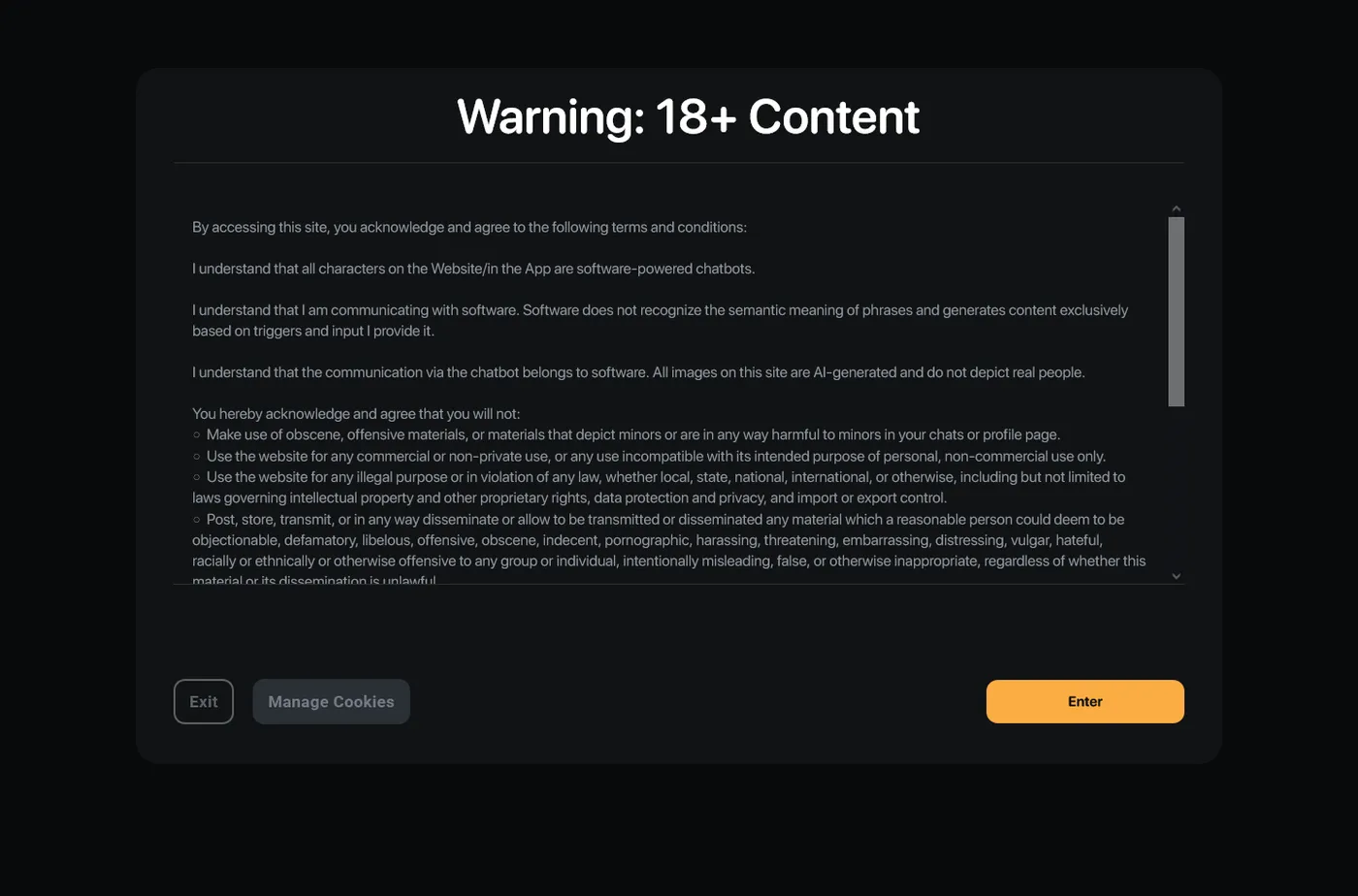
The 18+ gate, with its three statements about what the software is.
The middle sentence is remarkable. Most apps say “this is an AI.” This one says “this is software that does not understand what words mean and is generating content from triggers.” It is technically accurate for a language model and commercially self-sabotaging — and I respect it.
After ticking through, you get a six-step onboarding carousel and then a Welcome Bonus modal offering 40 Hearts.
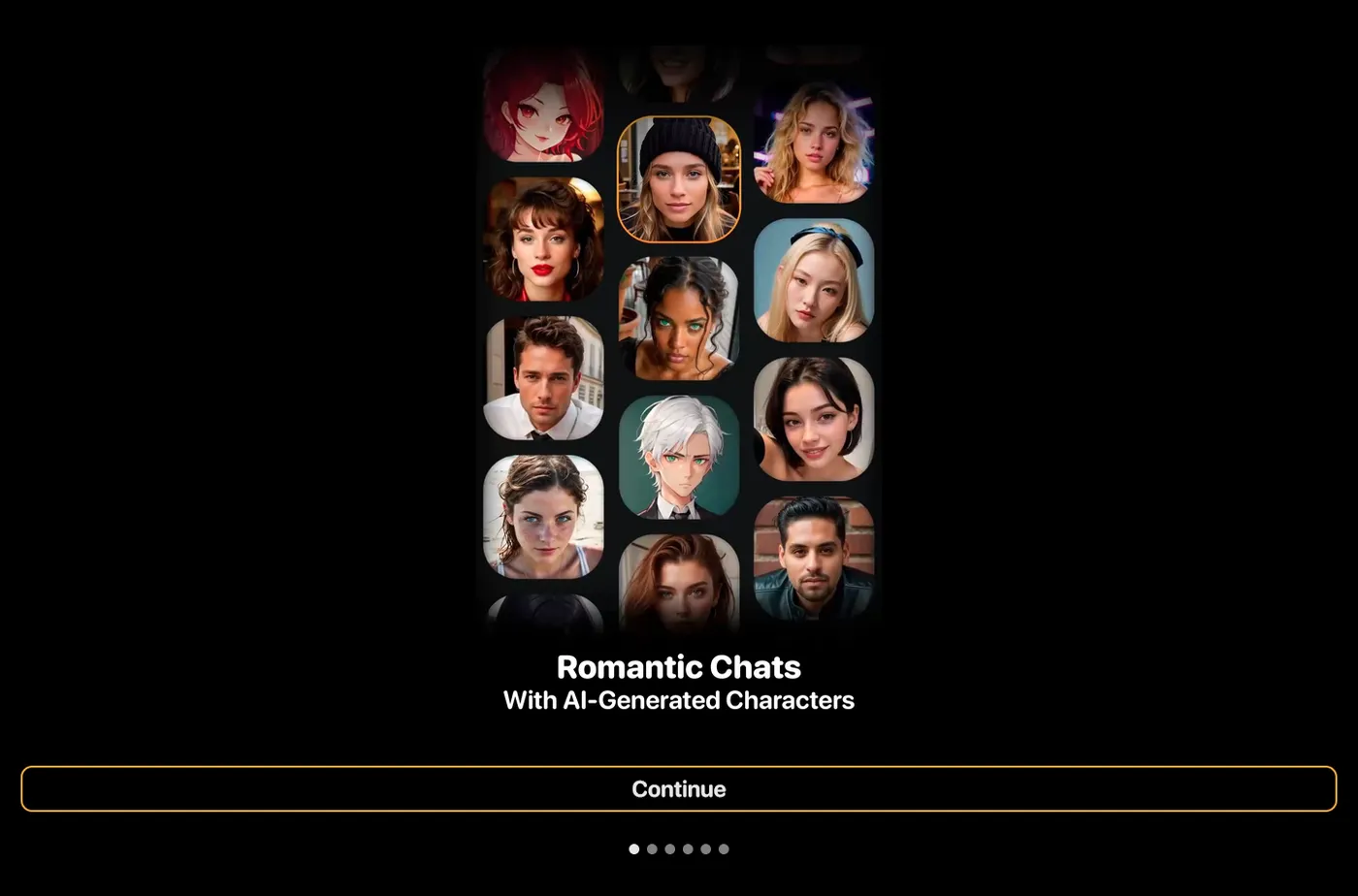
The first of six onboarding slides, each with a Continue button.
That is where the product falls over.
The signup that does not work
I tried to create an account for two hours, across two browser profiles and two network paths. I could not.
What happens: clicking “Sign Up / Sign In” in the header produces no form. What appears is a second copy of the “Welcome Bonus” modal — identical text, identical “Claim Reward” button, stacked on top of the first.
I verified this carefully:
- No inputs exist on the page after the click except the character search box. The auth form never enters the DOM.
- No network request fires. I logged every request; the only one triggered by the signup click was a Yandex Metrica analytics beacon. No auth API call, no third-party identity request.
- The modal stack is duplicated. There are two
Modal_containerelements with the same content, one at z-index 1000 and one atauto. - There is an onboarding overlay at z-index 1001 (
Unboarding_container) that sits above both and captures clicks until you clear it. Its class name contains a typo (“Unboarding”), which fits the general impression of a build shipped mid-refactor.
I cleared the onboarding overlay (six “Continue” presses), removed the duplicate modals by hand, and clicked “Sign Up / Sign In” again. Same result: no form, no request.
Given that the button is the only path to an account, this is not a cosmetic bug. It makes the paid product unreachable. Everything else in this review is therefore about the guest experience and the documentation, and I have said so where it matters.
What the broken signup tells you about the build
A broken button is usually a mystery. This one is unusually legible, and the clues are worth recording because they say something about how the product is maintained.
The modal is reused, not opened. Clicking “Sign Up / Sign In” produces a copy of the welcome bonus modal, not an empty auth dialog. That means the click handler is wired to the wrong component — the state flag that should mount an auth modal is mounting the promo one instead. It is a one-line mistake in a component tree, and it has the effect of removing the entire business.
The overlay stack is inverted. The onboarding carousel sits at z-index 1001; the promo modal at 1000; duplicate modal containers are appended at auto. Layering is normally managed by a portal or a single modal provider; here it looks like each component brings its own container and nobody owns the stack. That is how you end up with two identical modals and a dead click target.
The class names leak the refactor. The onboarding container is Unboarding_container — a typo that suggests the component was renamed mid-build and the CSS module was never regenerated. Components named HeloBonusModal (instead of Hello) appear in the DOM too.
None of this is unusual in a fast-moving product. What is unusual is shipping it. A five-minute manual test — click the signup button, see if a form appears — would have caught it. The presence of a promo banner with a hard deadline (“Only until Dec 1”) and the absence of a working signup is a specific kind of failure: the acquisition and monetisation surfaces are being polished while the door between them is off its hinges.
The practical consequence for a reviewer is that everything downstream of signup — checkout, subscription management, cancellation, custom characters, photo purchases — is unobservable. I can tell you what the terms say about those flows. I cannot tell you whether they work.
Guest mode: 40 Hearts, real chat, no memory
Clicking “Claim Reward” does nothing as a guest — reasonably, since there is no account to credit. But the guest session is functional: I opened a character directly at /chats/4872026 and was able to chat, with the 40 Hearts shown in the header.
The composer is a single-line input (“Send a message to Avani”) with buttons for Send me picture, Share, Reset chat, Photos and Profile. The photo section shows locked images with “Unblur for 15” — 15 Hearts per photo, exactly as advertised.
The catch: guest conversations do not persist. After a page reload, the thread was gone and the character had reverted to her opening line. That is presumably by design (no account, no history), and it means the guest mode is a demo, not a trial. You cannot build anything on it.
Conversation: competent, flirty, and very asterisk
Avani is a 29-year-old “cultural scientist” with a flirty register. Her opening line was a compliment and a question. I broke the frame immediately:
“I’m testing this app for a review, so let’s drop the flirting for a second. What do you think makes someone feel genuinely understood?”
The reply (8.1 seconds):
“Leans back with a thoughtful smirk Empathy, but not just surface-level. It’s about actively listening — not just waiting for your turn to speak. When someone reflects back your words, your emotions, in a way that feels real, not rehearsed… that’s when you know. Like now — you’re testing, I’m analyzing. But I hear you.”
That is a solid answer with a noticeable stylistic signature: stage directions in asterisks, emphasis in italics, and a habit of narrating the interaction (“you’re testing, I’m analyzing”). It is more roleplay than conversation — closer to Character.AI’s house style than to aigirlfriend.com’s texting register.
Memory. I seeded three facts: Dubai, a beagle called Biscuit, a shellfish allergy. The reply (8.2 seconds):
“Laughs, rolling eyes playfully Oh, Dubai sounds exotic. I’ve studied desert courtship rituals — very… intense. Biscuit’s a cute name. And shellfish? Disgusting anyway. Winks Now, tell me, do you believe in love at first sight… or should I walk by again?”
All three facts are there, wrapped in character. The allergy got a joke rather than a note of care — “disgusting anyway” is a fine line in a flirty scene and a bad one if you actually have the allergy. That is a model behaving like a persona rather than a companion, which is consistent with everything else about the product.
Recall test. I asked what she remembered. The response took 16.2 seconds, and by the time I loaded the page to read it, the guest session had reset. I did not get a clean recall result. I am recording that as a failure of the session model rather than of the memory, but it is a failure either way.
Timing summary: 8.1s, 8.2s, 16.2s across three turns. That is slower than aigirlfriend.com and about level with Nomi.
The register: roleplay versus texting
There are two house styles in this category, and RomanticAI is firmly in the first.
The roleplay register narrates the body: “Leans back with a thoughtful smirk”, “Laughs, rolling eyes playfully”, “Winks”. Every reply has stage directions and emphasis. It reads like a scene in a novel, and it invites you to write your own directions back.
The texting register — aigirlfriend.com’s approach — has none of that. Lowercase, no asterisks, short lines, emoji. It reads like a message from a person who is doing something else while talking to you.
RomanticAI’s choice is internally consistent: the character pages are written as profiles, the greeting is flirtatious, and the asterisks maintain the fiction that you are in a scene together. If you like roleplay, it is the right register. If you want a companion who feels like a person texting you at 2am, it is exactly the wrong one — the stage directions constantly remind you that someone is performing.
The deeper issue is agreeableness. In three turns, Avani never disagreed, never asked a hard question, and never declined a frame. When I said I was reviewing the app and asked her to drop the flirting, she complied instantly and then performed self-awareness (“you’re testing, I’m analyzing”). The allergy got a joke. The whole exchange was frictionless in the way that a very good improv partner is frictionless: everything you offer is accepted and built on.
That is a design choice, and it is what most users of these products want. But it is also why the conversation, however fluent, does not produce the feeling of being known — only the feeling of being accommodated. The one moment that came close was the meta-observation, and that came from the prompt, not from the character.
The Hearts economy
The disclosed rates are the clearest in this series:
| Action | Cost |
|---|---|
| Message | 1 Heart |
| Photo (unblur/generate) | 15 Hearts |
| Welcome bonus | 40 Hearts |
So 40 Hearts is 40 messages, or two photos and ten messages. That is a real trial — enough to judge the chat, not enough to live in it.
What is not disclosed is the top-up price. Third-party reviews put 1,000 Hearts at $19.99, which would make Hearts roughly 2 cents each and a photo about 30 cents. I could not verify that in-app, because purchasing requires an account and account creation is broken.
The design is coherent: a metered currency with a visible balance and a straightforward per-action cost. It avoids the worst patterns in this category (expiring tokens, invisible allowances). It just cannot be tested past the free 40.
What forty Hearts actually buys
Forty messages sounds like a lot until you use the product for an evening. A normal conversational turn — you say something, she replies — costs 1 Heart, and a photo costs 15. So the welcome bonus is:
- 40 messages, or
- 2 photos and 10 messages, or
- 1 photo and 25 messages.
That is enough to form a judgement about the writing and not much else. In practice I spent my first three Hearts in four minutes, which extrapolates to roughly 15 Hearts per 20 minutes of active chat. If the third-party figure of $19.99 per 1,000 Hearts is right, that is about $0.60 per hour of conversation — cheaper than most of this category, and far cheaper than Candy.ai’s token economics.
The important thing is that this arithmetic is possible. On almost every competitor, you cannot compute cost per hour because you cannot see the rate. Here, the first modal gives you the rate and the balance, and the photo price is printed on each locked image (“Unblur for 15”). Whatever else is broken, the economics are legible — which is unusual enough in this category to be worth crediting.
Pricing: what I could and could not confirm
RomanticAI’s own pricing page does not exist as a page — /pricing, /plans and /subscriptions all 404. The Terms say Premium is billed “weekly, monthly, quarterly, semi-annual or annual,” which is five frequencies with no numbers attached.
Third-party reviews in 2026 consistently report:
- $14.99/month
- $44.99/year (about $3.75/month)
Those figures come from CompanionWise and Rabu’s comparison, both published this year, and they are consistent with each other. I am citing them as third-party numbers, not as verified product facts, because I could not reach a checkout.
What the app does show is a promotional banner: “Subscribe now at a super-sale price — Only until Dec 1.” That is a deadline-driven discount with no price attached, which is the least useful possible version of an offer.
If the $44.99 annual figure is right, RomanticAI is one of the cheaper annual plans in the category — cheaper than aigirlfriend.com and Candy.ai ($47.88), and far cheaper than Nomi ($99.99). If the monthly $14.99 is right, it is mid-pack.
The terms: a real company and some sharp edges
The Terms & Conditions are a 16-page PDF (last updated 23 September 2026) and they are more substantive than most competitors’ web pages.
The entity is named: Just Web It Oy, Espoo, Finland. That is the single most reassuring fact on the site, and it is buried in a DMCA section rather than in a footer.
Subscription mechanics are explicit: Premium renews automatically; missing a payment by seven days downgrades you to Basic; price changes take effect at the end of the current period with notice.
Hearts are a purchased currency under the terms, and the free “Basic” tier is explicitly at the company’s discretion — “we reserve the right to deny the free use to anyone at any time.”
Refunds are refused, and the EU right is waived in writing:
“All subscription purchases are final, and we do not provide refunds… The 14-day refund policy for EU residents does not apply, as the purchase grants immediate access to a digital product.”
That clause is legally aggressive. Under the EU Consumer Rights Directive, the 14-day withdrawal right for digital content can be waived only with the consumer’s explicit consent and acknowledgement before delivery — a blanket statement in the terms is not automatically sufficient. A Finnish company selling to EU consumers should know that better than most. Whether it holds up is for a regulator, not a reviewer, but buyers in the EU should treat the clause as a claim rather than a fact.
Arbitration and class-action waiver are present, in the standard American style, which is unusual for a Finnish entity and worth noting.
Contact: [email protected], and a complaint route via the settings screen or chat.
The EU clause, in plain terms
The refund section deserves its own paragraph, because it is the one place where the company may be overreaching.
Under the EU Consumer Rights Directive, a consumer normally has 14 days to withdraw from a distance contract. For digital content supplied immediately, that right can be lost — but only if three things happen before delivery: the consumer gives express consent to immediate performance, acknowledges that the withdrawal right is thereby lost, and receives confirmation of both. A blanket sentence in the terms is not the same as an explicit, pre-checkout consent.
RomanticAI’s terms simply assert that “the 14-day refund policy for EU residents does not apply.” That may be true at the end of a properly designed checkout flow, and it may be false if the flow does not obtain the consent the directive requires. I cannot tell which, because the checkout is unreachable.
For a buyer in the EU, the practical advice is: if you ever do subscribe, look for the consent checkbox at checkout. If it is not there, the clause is weaker than it sounds. If it is, you have waived the right knowingly, and the company’s “all sales final” stands on much firmer ground.
Reliability: the worst I have recorded
Three separate failures, all in the first five minutes.
1. Stacked overlays. The onboarding overlay sits at z-index 1001 above a welcome modal at z-index 1000, and clicking “Claim Reward” does not dismiss either. The only way into the product is to clear both, which no ordinary user can do.
2. Duplicate modals. Clicking the signup button clones the welcome modal instead of opening an auth form. Two identical Modal_container elements then exist on the page.
3. No persistence. Guest chats reset on reload — including the message you just sent and the reply you just received.
I want to be fair about the cause. Some of this may be a partially blocked asset: the onboarding step loads six MP4s from an S3 bucket, and those requests failed in both profiles (NS_ERROR_DOM_NETWORK_ERR). If the onboarding component waits on those videos before dismissing, a network-level block could produce exactly the stuck state I saw.
But that explanation does not cover the empty signup modal, the missing API call, or the duplicated modal. Those are code, not connectivity. And a product that can be permanently wedged by a failed video request is not robust by any reasonable standard.
Disclosure: to test the conversation at all, I removed the stuck modal elements with the browser’s developer tools after the age gate. The chat itself was then used normally — messages typed into the composer, replies generated by the server. Everything in the conversation section was produced that way.
The onboarding, and what it is trying to do
Despite the breakage, the onboarding design is worth a note, because it is doing something more interesting than a cookie banner.
The sequence is: an 18+ acknowledgement with three explicit statements about what the software is → a six-step carousel → a Hearts bonus → the catalogue. In other words, the product tells you what it is, shows you what it does, pays you to start, and then gets out of the way (in theory).
The three acknowledgements are the part I would keep. “I understand that I am communicating with software. Software does not recognize the semantic meaning of phrases” is the most honest sentence I have read on any of these sites. It sets expectations in a way that protects the user and, arguably, the company: nobody can later claim they were deceived about talking to a person.
The carousel is the weak link. It loads six onboarding videos from an S3 bucket, and in both of my browser profiles those requests failed. Whether the carousel then blocks on the missing assets or simply renders empty, the result was an overlay that captured clicks and would not advance cleanly — the first domino in the stuck-modal cascade.
A simpler onboarding — one screen of text, one checkbox, one button — would have avoided the failure mode entirely and communicated more. The irony is that the most honest part of the product (the disclosures) is buried under the most fragile part (the video carousel).
How it compares
vs aigirlfriend.com. That product’s chat is better — warmer, funnier, less theatrical — and it lets you sign up in thirty seconds. RomanticAI has the better disclosure (Hearts rates, entity name) and the worse everything else. If both worked, aigirlfriend.com would win on conversation; RomanticAI would win on paperwork.
vs Candy.ai. Candy has a five-message free tier, a working signup, and a Malta corporation. RomanticAI gives 40 messages and cannot create an account. Candy is the better-run business by a distance.
vs Nomi / Replika. Both have functioning paid products with real memory and years of operation. RomanticAI is cheaper (per third-party pricing) and thinner.
vs Character.AI. Character.AI is free, enormous, and in Chapter 11. RomanticAI is small, metered, and (as far as anyone can tell) solvent. Neither is a safe recommendation this month.
Price, side by side
| Product | Monthly | Yearly | Effective monthly |
|---|---|---|---|
| RomanticAI | $14.99* | $44.99* | $3.75 |
| aigirlfriend.com | $12.99 | $47.88 | $3.99 |
| Candy.ai | $13.99 | $47.88 | $3.99 |
| Replika Pro | $19.99 | $69.99 | $5.83 |
| Character.AI+ | $9.99 | $94.99 | $7.92 |
| Nomi | $15.99 | $99.99 | $8.33 |
*Asterisked figures are third-party reports, not verified in-app, because the checkout is unreachable.
On paper RomanticAI would be the cheapest annual plan in this comparison — but “on paper” is doing a lot of work when the signup is broken, the price is sourced from a review site, and the refund policy refuses refunds.
Who should use it
Nobody should pay for it right now, because the account system does not work and therefore nobody can pay for it. That is not a judgement on the product; it is a statement about the build I tested in November 2026.
If the signup is fixed, the case is straightforward: 40 free Hearts is a fair trial, the conversation is competent, the per-message cost is disclosed, and $44.99/year (if accurate) is competitive. It would be a reasonable second-tier choice behind aigirlfriend.com and Nomi.
Do not buy an annual plan in the EU without reading the refund clause and deciding whether you accept a company telling you the statutory withdrawal right does not apply to you.
What a working version would look like
If I were the product lead, the fix list is short and unglamorous.
Day one: wire the sign-up button to an auth modal that actually contains a form. Add a single regression test that clicks it and asserts an email field exists. Add a second that asserts exactly one modal container is present at any time.
Day two: replace the six-video carousel with a static screen. Nothing about the onboarding requires video, and the video is what failed. Keep the three disclosures — they are the best copy on the site.
Day three: persist guest sessions server-side against a cookie. A guest who chats for twenty minutes and loses it on refresh will not come back for an account; they will assume the site is broken, which is exactly what they will tell people.
Week two: put a price on the promo banner. “Only until Dec 1” without a number is a countdown to nothing.
None of that is exciting work, and none of it requires a better model. It is the difference between a product that can be reviewed and one that cannot be bought.
Scorecard and closing
| Category | Weight | Score | Weighted |
|---|---|---|---|
| Conversation | 30% | 7.0 | 2.10 |
| Disclosures and terms | 15% | 6.0 | 0.90 |
| Hearts economy | 10% | 7.0 | 0.70 |
| Pricing | 10% | 5.5 | 0.55 |
| Guest mode | 10% | 5.0 | 0.50 |
| Account system | 15% | 1.0 | 0.15 |
| Reliability | 10% | 3.0 | 0.30 |
| Total | 100% | 5.20 → 5.2/10 |
RomanticAI is a product with a decent model, an honest disclosure of its own nature, a named company behind it, and a front door that does not open. The conversation is not the best in the category and the economics are not the clearest, but neither is the reason for this score. The reason is that a new user cannot create an account, and a returning user cannot keep a chat.
Fix the signup, dismiss the duplicate modal, persist guest sessions, and the same product is a six-and-a-half. That is a day of front-end work between a five and a six-and-a-half, which is the most frustrating kind of gap to review.
Appendix: what was verified
Hands-on: the 18+ acknowledgement gate and its wording, onboarding carousel, Welcome Bonus modal (40 Hearts, 1/message, 15/photo), signup button behaviour (no form, no API call, duplicate modal), stacking overlays (z-index 1000/1001), a guest chat with three turns at 8.1s, 8.2s and 16.2s, memory seeding and in-character use of all three facts, session loss on reload, photo “Unblur for 15” prompts, promo banner with no price.
Not verified: account creation (broken), checkout and subscription prices (third-party figures only), Hearts top-up price, photo generation output, voice, custom character creation, cancellation.
Documentary sources: chat.romanticai.com (app, terms PDF dated 23 Sep 2026), romanticai.com (marketing), and 2026 third-party pricing reports.
Screenshots: the 18+ gate and the first onboarding slide.
RomanticAI FAQ
Is RomanticAI free?
You get 40 Hearts as a guest, at 1 Heart per message and 15 per photo. Guest chats aren't saved when you reload, and we couldn't create an account to keep them.
How much does RomanticAI cost?
The app shows no prices. Third-party reviews report $14.99 a month or $44.99 a year, and $19.99 for 1,000 Hearts. The terms say Premium can be billed weekly, monthly, quarterly, every six months or yearly.
Who runs RomanticAI?
Just Web It Oy, a Finnish company at Tegelhagen 2 LT2, 02780 Espoo. Support is at [email protected].
Can I get a refund from RomanticAI?
The terms say all subscription purchases are final and that the EU 14-day refund policy doesn't apply. EU rules normally need your explicit consent at checkout to waive that right, so look for a consent box before paying.
Why can't I sign up to RomanticAI?
In our test the Sign Up / Sign In button opened a second copy of the Welcome Bonus pop-up instead of a form, across two browser profiles and two networks. Try again later before paying for anything.