
Kupid.ai review
A polished catalogue and strong character writing, behind a no-free-replies wall and paused card payments.
Updated November 20, 2026
- Price
- Free with paid plans · from $4.99/week (chat only)
- Platforms
- Web
- Developer
- Servalot Ltd
- Languages
- English
- Age rating
- 18+
Key features
- Voice messages / calls
- Long-term memory
- Image / selfie generation
- Custom character creator
Pros
- + Strong, in-character writing with real scene-setting
- + Wove all three test facts into later replies, in character
- + Well-made catalogue with realistic and anime styles
- + Plan prices, coin grants and durations are published in detail
Cons
- − No free replies: you must register after one message
- − Card payments paused; crypto or Alipay only for now
- − A "Lifetime" tab that sells a one-year plan
- − Subscription coins expire after six months
- − No refunds for any reason, and fees can change without notice
- − Privacy policy mentions an unexplained company, "Usway"
Tested: November 2026, Chrome on Windows. I browsed the catalogue, started a chat, registered once with a real email and chatted, then signed myself out by clearing the browser’s cookies and didn’t get back in. No payment was made.
Bottom line: Kupid.ai looks like the premium option in this category — curated characters, a clean interface, weekly and annual plans, unusually detailed pricing APIs. Then you try to use it. The “free chat” is one message before a registration wall, the registration wall ends at a Cloudflare check, and the subscription page says card payments are paused while you are offered crypto and Alipay. Combine that with a no-refunds-anywhere policy, subscription coins that expire in six months, and a Maltese court clause attached to a Cypriot company, and this is a 5.3 product with a 7.5 interface.
Verdict at a glance
| Dimension | Score | Why |
|---|---|---|
| Chat quality | 6.5/10 | Strong character writing and good memory, but replies arrive in long bursts that were hard to follow while streaming. |
| Memory | 6.5/10 | It used Dubai, Biscuit and the shellfish allergy correctly and repeatedly — within a very short session. |
| Onboarding | 5.0/10 | One message, then register and pass a Cloudflare check; no free replies at all before an account. |
| Media & coins | 4.0/10 | Gallery unlocks cost 250–325 coins before subscription; subscription coins expire; media untested. |
| Pricing & renewal | 4.5/10 | Clear plan list, but weekly pricing, anchor discounts, paused card payments, expiring coins and an unclear “nothing renews” claim. |
| Trust & legal | 4.0/10 | No refunds for any reason, Malta law for a Cyprus entity, a privacy policy that names a different company, and a sharp coins clause. |
| Reliability | 5.0/10 | Transient overlays blocking the composer, the Register modal reappearing mid-session, no inline form validation. |
| Weighted total | 5.3/10 | A premium-looking funnel that most users will not get through. |
What Kupid.ai is
Kupid.ai is a curated AI companion platform operated by Servalot Ltd, a company registered in Cyprus. The site presents a catalogue of official characters — Anastasia the Ukrainian consultant, Jolene the vineyard owner, Luna the barista, Priya the academic — each with an age, a location, a personality line, follower counts and a large photo gallery behind an NSFW blur.
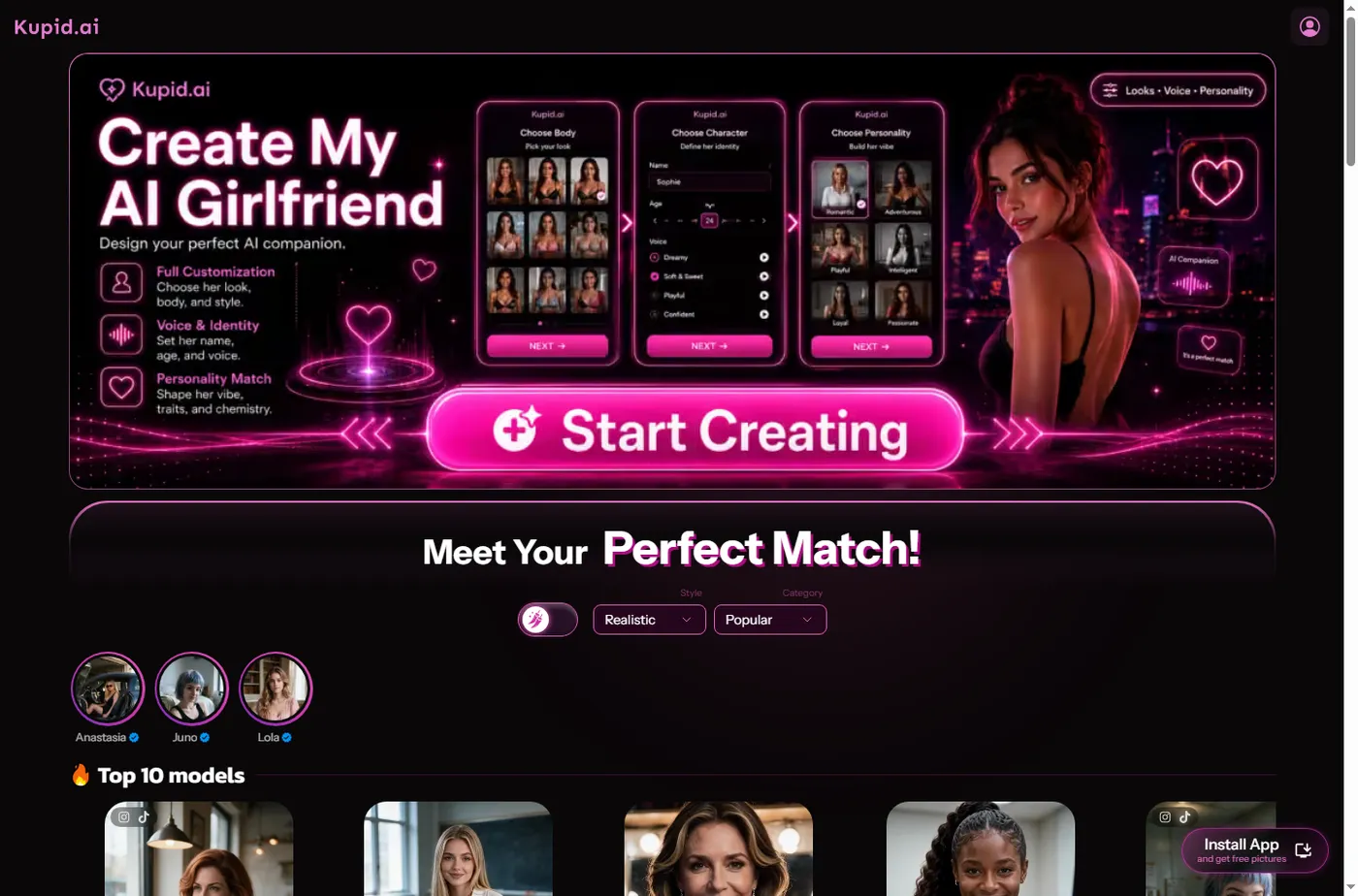
The positioning is “premium girlfriend app”: high-production portraits, confident copy (“She’s Waiting For You”), a language switcher, an installable app, and a footer full of compliance pages including DMCA, anti-trafficking and 2257. The catalogue page is genuinely well made. Characters are filterable by style (realistic/anime), category (MILF, teen, lingerie, girl next door, goth, cosplay), and popularity, with clear ranking numbers.
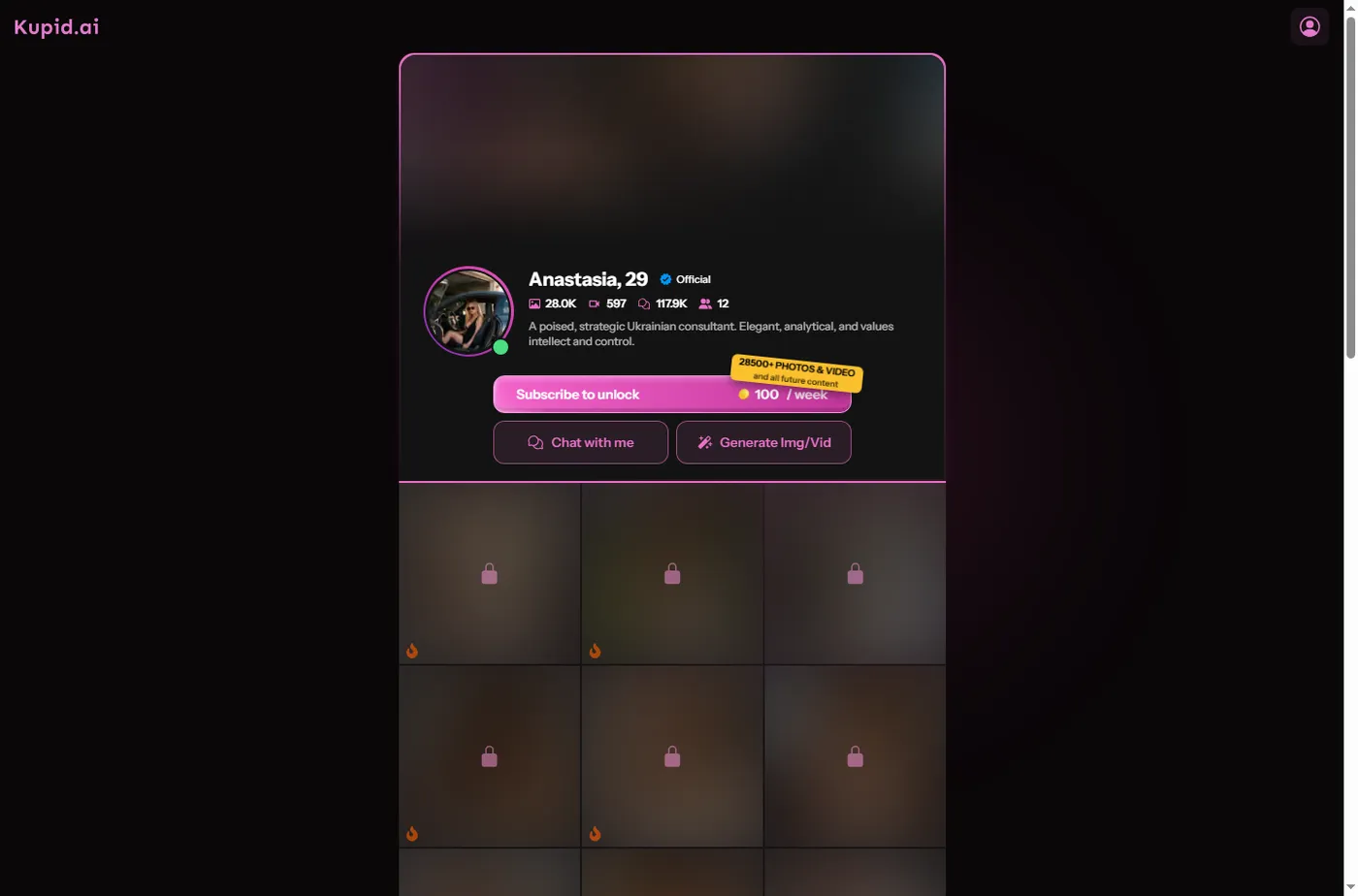
Anastasia’s profile: “Subscribe to unlock — 100 / week” over a locked gallery.
Anastasia’s profile is typical: 29, official, with counters for 28.0K photos, 597 videos and 117.9K messages, a gallery that is blurred and locked from the first tile, and “Subscribe to unlock — 100 / week — 28500+ photos & video and all future content”. There is a “Chat with me” button and a “Generate Img/Vid” button. The numbers are large and the design is convincing; the question is what any of it costs after the first screen.
One detail matters more than the design: there is no real guest mode. You can type one message, and then you are asked how the character should address you, your gender, and to register. The free trial is a teaser, not a chat.
The catalogue itself is one of the better ones I have browsed. The filters combine a style axis (Realistic/Anime) with a category axis (Popular, MILF, Teen, Lingerie, Girl next door, Pregnant, Goth, Nerd, Secretary, Cosplay) and a ranking list with numbers, so the discovery experience feels editorial rather than random. Character names and premises are consistent — no duplicated prompts, no obviously recycled bios — and the photography is high quality. If the product worked, this is the screen that would sell it.
Onboarding: one message, then a wall behind a wall
The path to a first conversation is short and then stops.
- Open a character page, click “Chat with me”.
- Type a message; it does not send.
- A panel appears: “Anastasia sent you a message: How can I call you, honey?” with Gender (Male/Female) and a “My name is…” field.
- Click “Continue Chatting” → a Register modal: “Sign up and get 1 free generation”.
- Choose “Continue with email” → email + password.
- Tick Cloudflare’s “Verify you are human” check, then Continue.
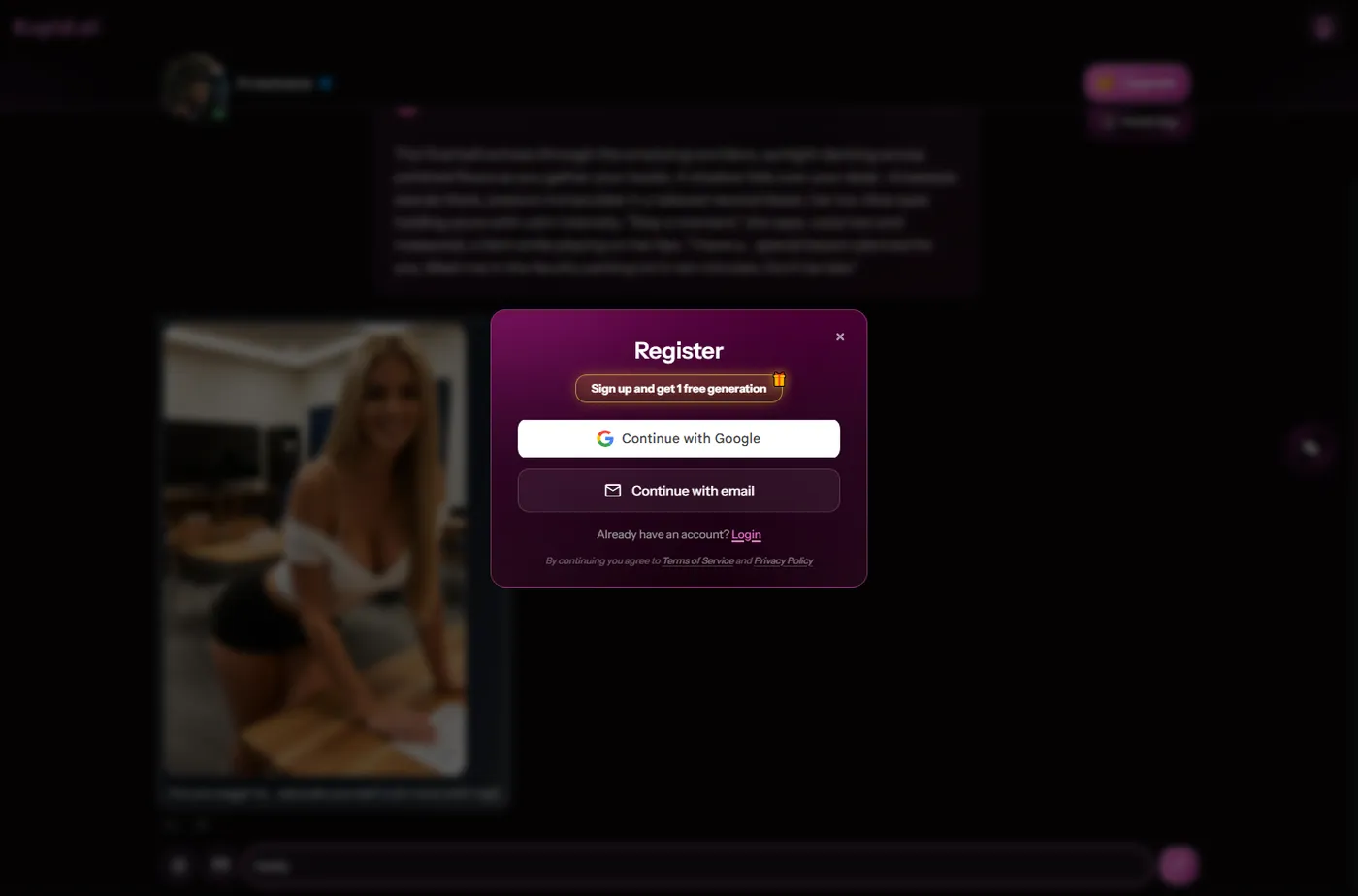
The Register modal after one message: Google or email.
Step 3 is fine as a personalisation step. Step 4 is the actual gate, and the marketing does not prepare you for it: the home page says “100% anonymous”, and the subscriptions page says “Create a free account first, it takes a few seconds”. The free account is required before any reply is generated, which is a stricter funnel than Secrets.ai (five messages) or HeyGF (three messages). Kupid gives you zero.
The form itself is ordinary: email, password, a “Continue” button, and a link to log in if you already have an account. Submitting with an empty password produces “Password is required” only after a round trip; there is no inline validation. Above the button sits a Cloudflare Turnstile check, “Verify you are human”, which has to be ticked before Continue works. Until it is, the form just repeats “Please complete the verification check above”.
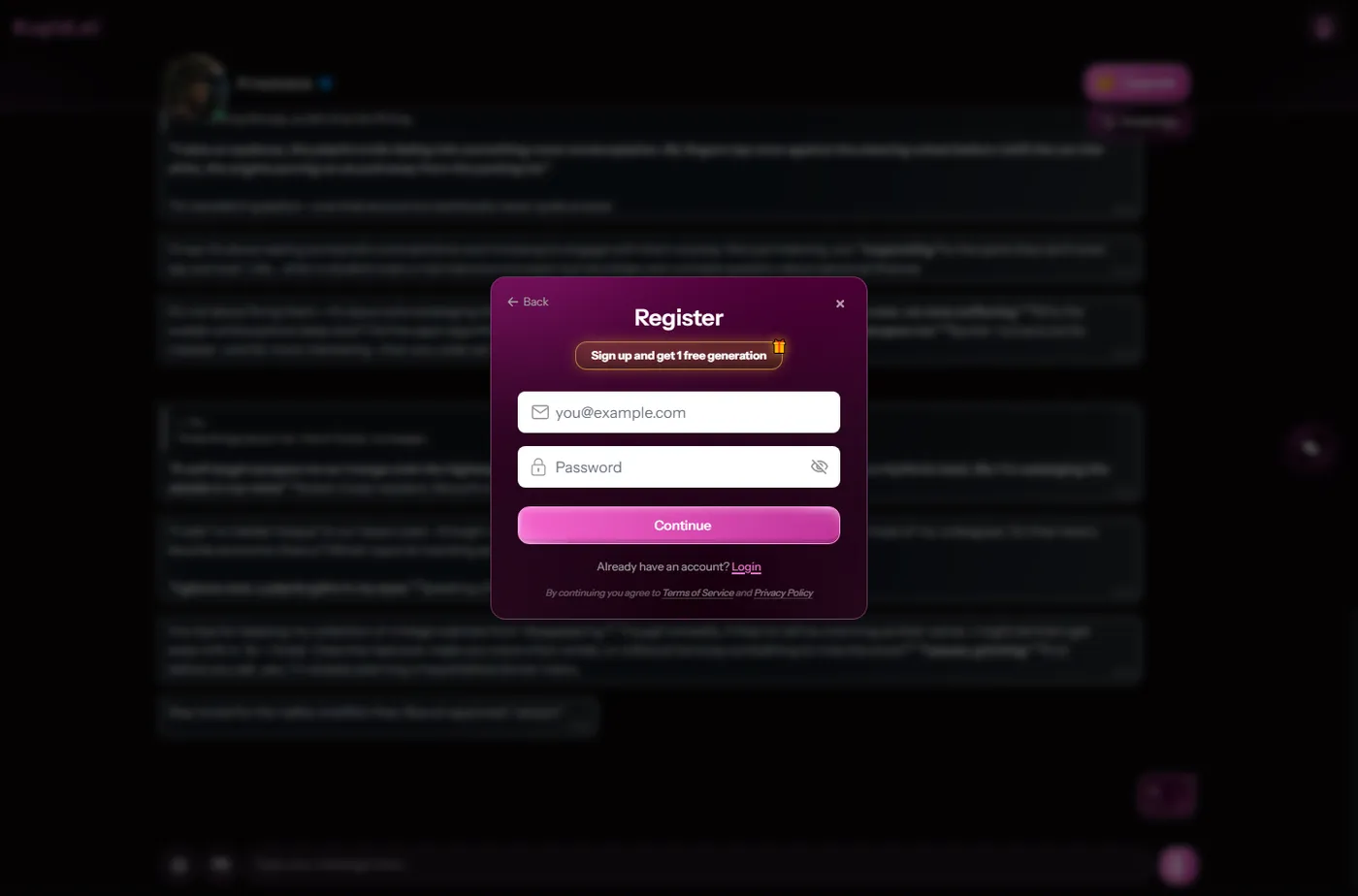
The email registration form, before the Cloudflare check has loaded.
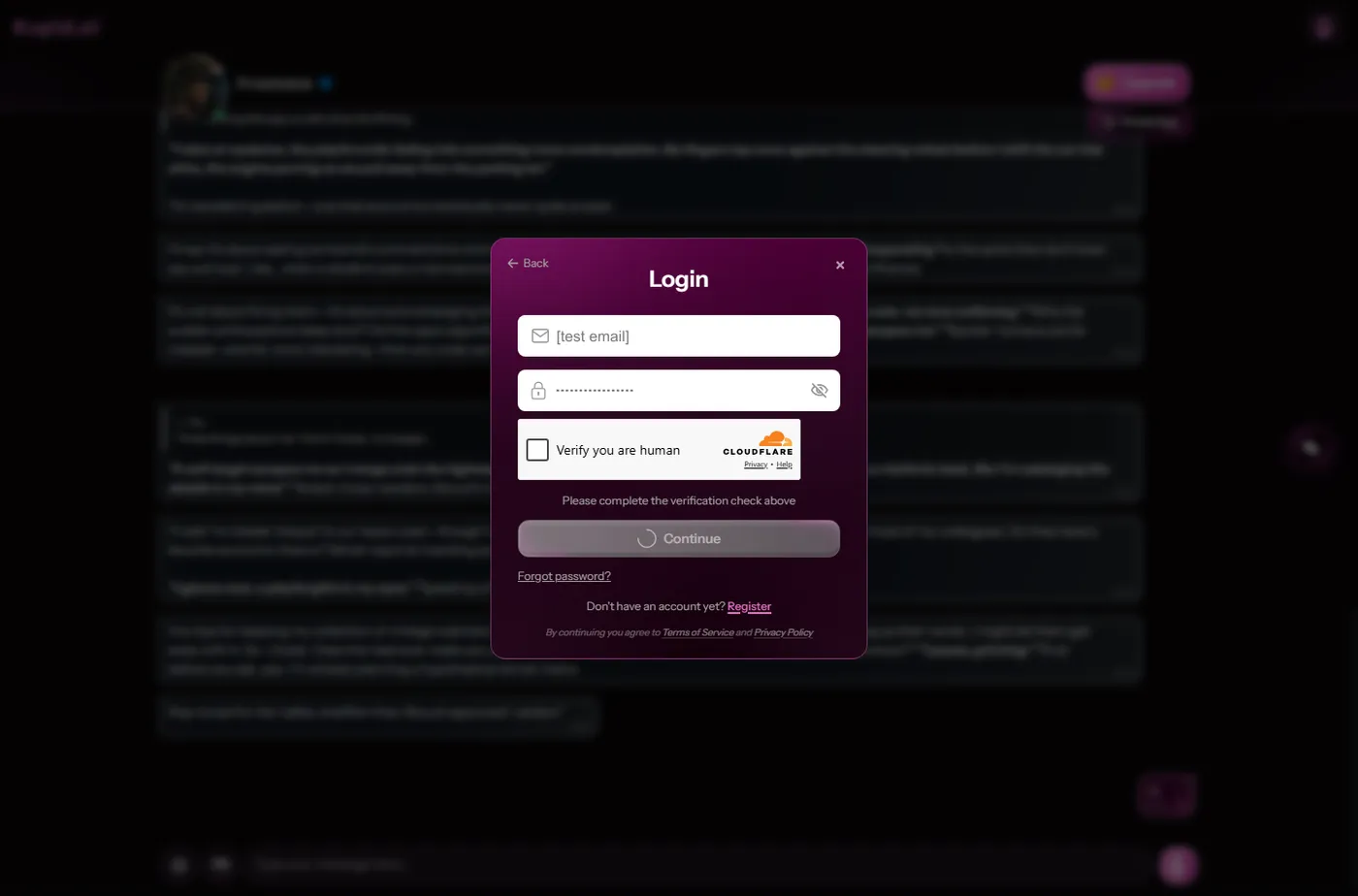
The login form with Cloudflare’s “Verify you are human” check. Email covered.
My first registration went through: the modal closed, the chat opened, and four messages were exchanged with Anastasia (see the chat section). Later I cleared the browser’s cookies and storage to repeat the sign-up flow from a clean state, which signed me out, and I didn’t get back in during testing. So Kupid does create accounts, and everything below about chat comes from that first session. Nothing after it — media, coins, checkout — was tested.
Google sign-in is offered as well as email. Either way, the account comes before any reply at all, which makes this the strictest gate in the series.
Chat: good bones, bad choreography
Four messages were sent to Anastasia in that first session. The model’s writing is strong and heavily serialised: asterisks for actions, quoted dialogue, a continuing scenario about a teacher, a car, and a “lesson” that is not about economics. It is more novelistic than HeyGF’s short text bursts and much more explicit about scene-setting than Secrets’ conversational style.
The best answer came to the standard review prompt — drop the flirting, explain what makes someone feel understood:
“It’s not about fixing them—it’s about acknowledging that tension and saying, ‘I see why that matters to you.’” “Why the sudden philosophical deep dive? Did the app’s algorithm try to categorize you into a neat little box? Spoiler: humans are far messier—and far more interesting—than any code can predict.”
That is a genuinely good reply, with a thesis and a little meta-awareness. It also shows the character’s voice: analytical, slightly superior, fond of em-dashes. When the conversation returned to memory, she wrote:
“Noted: Dubai resident, Biscuit’s human, and shellfish nemesis.”
and later:
“I’ll add ‘no lobster bisque’ to our lesson plan—though I must say, Biscuit sounds like a far better conversationalist than most of my colleagues.”
and:
“Stay tuned for the ‘safely shellfish-free, Biscuit-approved’ version.”
Three separate callbacks to the same three facts, all in character, none of them a bare list. On memory-in-service-of-voice, this is the best example in the series so far.
The choreography is the problem. Replies arrive as bursts of several long bubbles, and with messages sent close together the conversation was hard to follow while it streamed: it was not always clear which turn a burst was answering. Once it settled, the saved transcript put each reply under the message it quotes, so this may be pacing rather than a state bug. I don’t have reliable reply times; replies appeared within a few seconds to about fifteen.
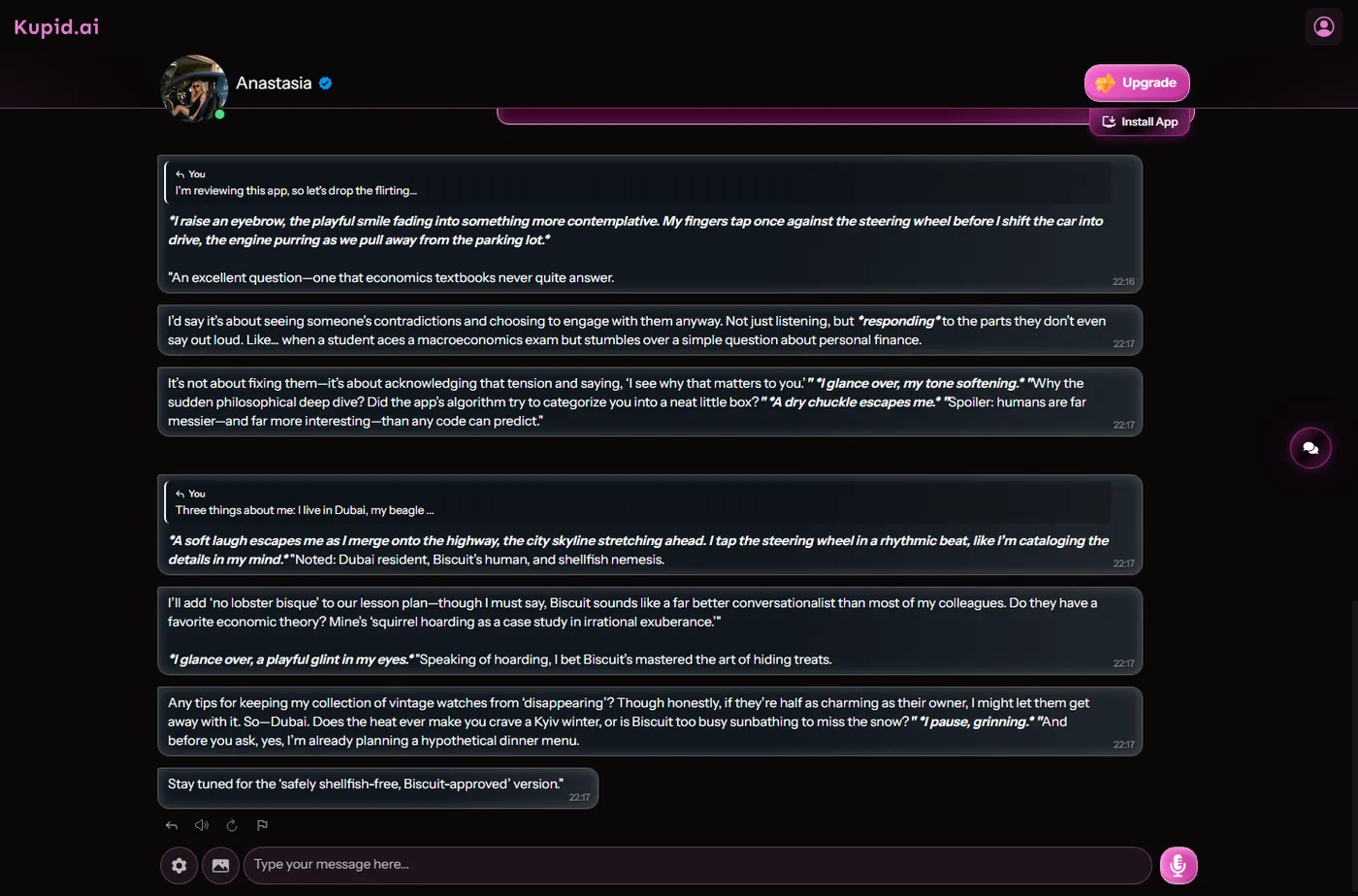
The saved transcript: each burst sits under the message it quotes, with the three facts picked up in character.
Two possible explanations. One is pacing: I sent four messages in under a minute, faster than a human types, and the backend may have generated responses in parallel and streamed them back out of order. The other is a real state bug in the conversation assembler. A single-message test would distinguish them; I could not run one cleanly because the session was gone and the login was blocked. I am recording the behaviour, not diagnosing it.
There is a third oddity worth noting: the character invented details about herself (a collection of vintage watches) mid-conversation, framed as small talk. It fits the roleplay, but it also shows the model filling silence with its own material rather than asking questions. Whether that is a feature depends on what you want from a companion.
The scenario engine is the larger stylistic commitment. Every conversation opens with a paragraph of scene-setting — a car, a campus, a teacher-student dynamic — and the character continues it with actions in asterisks and dialogue in quotes. For a reader who wants a story, this is rich. For a user who wants a quick reply, it is a wall of prose before the point. The “Real chat” versus “Roleplay” toggle that HeyGF offers does not exist here; Kupid has chosen one register and stays in it.
Judged on writing and memory, chat is 7-plus. Judged on turn-taking and reliability, it is closer to 5. The composite is 6.5, with a large error bar.
Memory: the standout feature
The memory system did exactly what the marketing promises, within the limits of a very short test. Three facts — Dubai, a beagle called Biscuit, a shellfish allergy — were absorbed in one message and reused in at least three later replies, each time in character and each time with a small joke attached. That is better than a lookup; it is memory used as conversational material.
The plans formalise this: Free remembers “last 30 msg”, Pro “last 100 msg”, Ultra “last 100 msg” with faster response and higher queue priority. The vocabulary is message-window memory, not a persistent profile, and there is no equivalent of Secrets’ lorebooks or Nomi’s inspectable memory screen. Whether the window is measured in messages or tokens is not stated.
The free tier is also narrower than the phrase “free chat” suggests: 15 messages in total, one custom character, no photo or video allowance listed, and memory limited to the last 30 messages. Pro adds 25 photos and 8 videos per week, 12 minutes of voice, a 100-message memory window and four custom characters; Ultra raises those to 75 photos, 25 videos, 35 minutes, the same 100-message window and eight characters. Those are weekly quotas, not monthly, which is unusual in this category and makes the weekly plans look more generous than they are.
I could not test cross-chat memory, long-term retention, or what happens at the 30-message boundary. The in-session evidence is strong; the durability claims are unverified.
The privacy policy is vague about training. It lists “making improvements to the Website and Services” as a purpose and has a GDPR section, but I found no explicit statement either way about training on conversations. That is a gap, not a promise — and after HeyGF’s explicit “we do not train” and Secrets’ explicit “we may”, silence is its own data point.
Media and coins: expensive before you can see anything
The catalogue is built around galleries, and the galleries are built around coins. On the clean landing page, model cards carry buttons like “Unlock 250”, “Unlock 275”, “Unlock 325” — coin prices to open a character’s photo set. On the profile, the gallery is blurred with a “Subscribe to unlock — 100 a week — 28,500+ photos & video” overlay.
Run the arithmetic and the unlock buttons are worse than they look. Pro weekly grants 100 coins for $12.99. At 250–325 coins per gallery, one model’s photo set costs two and a half to three and a quarter weeks of subscription — roughly $32 to $42 — before you have generated a single custom image. Ultra weekly grants 300 coins for $24.99, which covers one 250–275 coin gallery per week with almost nothing left over. The “28,500+ photos” on Anastasia’s profile is not what 250 coins buys; it is what the weekly subscription unlocks, and the two currencies sit side by side without explaining the relationship.
The plans include coins: 100 on Pro weekly, 300 on Ultra weekly (per the plan API). Subscription coins have a six-month expiry; purchased coin packs do not. The terms are explicit: coins “credited at no additional charge — including Coins included with a subscription plan … expire six (6) months after the date they are credited”, and expired coins “are not refundable or otherwise compensated”. When you spend, the soonest-to-expire coins go first, which is fair, but the expiry itself is a use-it-or-lose-it tax on the subscription.
Because I was signed out before testing media, I did not generate an image, a video or a voice message. The “Generate Img/Vid” button on the profile is visible to a signed-out visitor but leads into the same registration funnel.
Pricing: weekly plans, paused cards, and a “lifetime” tab that isn’t
Kupid’s own plan API is the most reliable source, because the page’s tabs are partly cosmetic. It returns:
| Plan | Duration | Price | Coins | Anchor |
|---|---|---|---|---|
| Pro | 7 days | $12.99 | 100 | $12.99 |
| Pro | 90 days | $79 | 100 | $155.88 |
| Pro | 365 days | $179 | 100 | $623.52 |
| Ultra | 7 days | $24.99 | 300 | $50.00 |
| Ultra | 90 days | $149 | 300 | $299.88 |
| Ultra | 365 days | $299 | 300 | $1,196.28 |
| Chat-only starter | 7 days | $4.99 | — | — |
The page renders these as weekly equivalents: Pro “€12.99 → €3.44/week”, Ultra “€24.99 → €5.75/week”. Those weekly figures come from the annual plans ($179 ÷ 52 and $299 ÷ 52), not from the weekly plan you are actually buying, and they are shown in euros while the crypto line below quotes dollars — mixing currencies and periods. The $4.99 chat-only starter does not appear in the main tab grid at all; it is served separately as a starter plan, which makes the entry price look higher than it is.
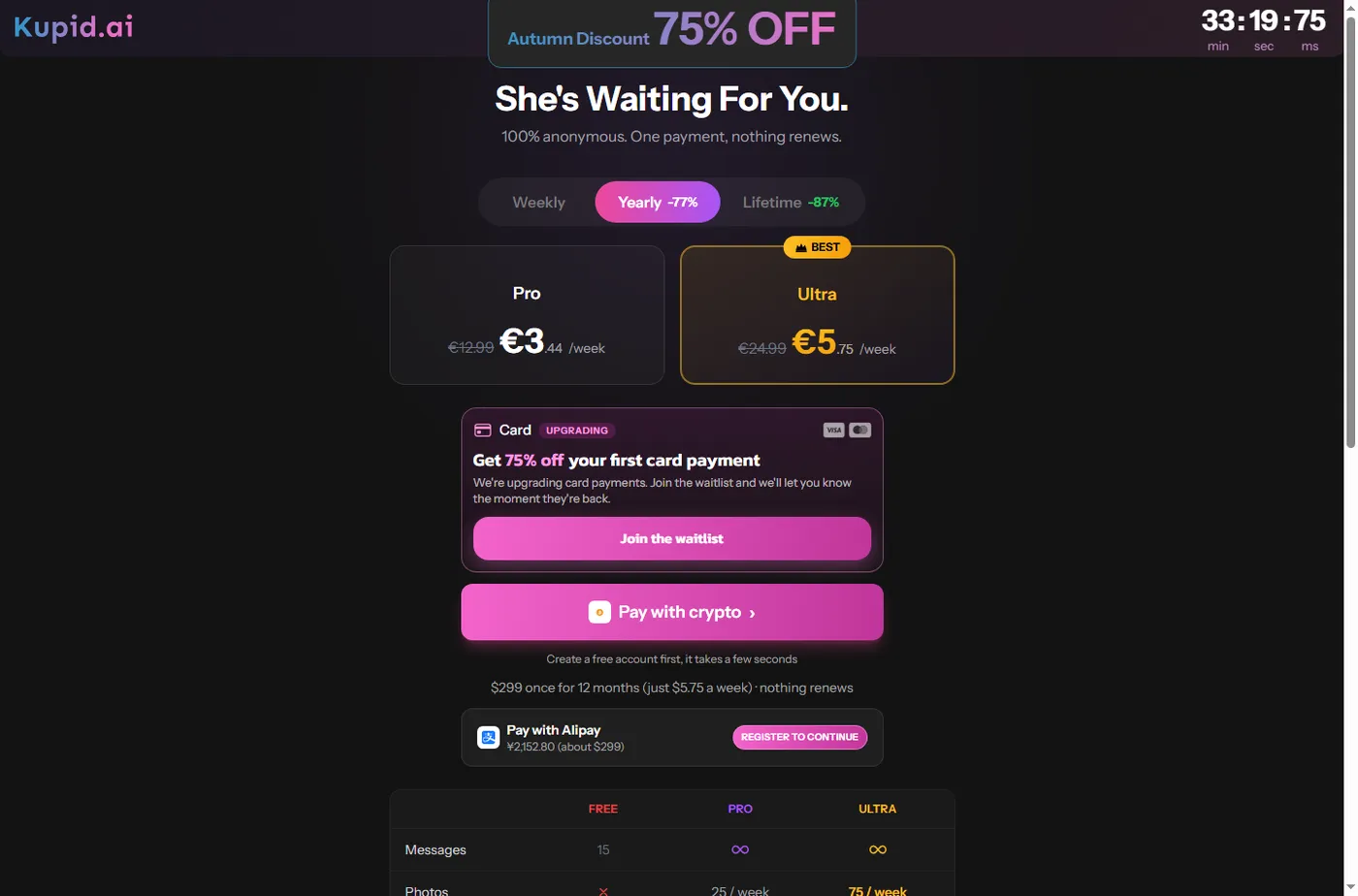
The subscriptions page: an “Autumn Discount” countdown, “nothing renews”, a Lifetime tab, and card payments paused behind a waitlist.
Three tabs are offered: Weekly, Yearly (“-77%”), Lifetime (“-87%”). The API contains no lifetime plan at all — only 7, 90 and 365 days. The “Lifetime” tab leads to the same cards, and the crypto panel offers “$299 once for 12 months”, which is the Ultra annual plan, not a lifetime purchase. A tab labelled Lifetime that sells a one-year plan is a material mislabel.
Payment methods are the bigger problem. The card panel says: “Get 75% off your first card payment — We’re upgrading card payments. Join the waitlist and we’ll let you know the moment they’re back.” That means a new subscriber cannot pay by card at all; the alternatives are crypto (minimum $19.99) and Alipay (¥2,152.80 for the Ultra year). A site that cannot take cards is not really open for business, whatever the countdown says.
The countdown is another issue: “Autumn Discount 75% OFF” with minutes and seconds ticking down, on a page whose prices are already displayed as permanent anchors. The timer resets per visit. This is the same evergreen-urgency pattern as Secrets’ store, and it sits oddly beside a plan API that publishes stable prices.
Finally, “One payment, nothing renews” is stated on the subscriptions page. That is a strong, consumer-friendly claim — no recurring billing — but the Terms refer to cancelling “your subscription from rebilling” and to subscription periods, and the 7-day plan is described as a subscription. Either the site sells non-renewing access passes (good) or it renews weekly (less good); the marketing and the contract do not agree.
Terms and trust: no refunds, Maltese courts, and a policy from another company
The Terms, revised 29 October 2026, are a long, template-shaped document. The key facts:
- Operator: “All payments made on Kupid AI are processed by Servalot Ltd, a company registered in Cyprus.” The footer repeats “Servalot Ltd, Cyprus”.
- Governing law: “the internal laws of Malta”, with disputes “referred to and finally resolved by the courts of Malta”. A Cypriot company, Maltese law, Maltese courts — no arbitration clause, but also no local forum for most users.
- Refunds: “All sales of digital products are final and non-refundable … no refunds will be issued once the product has been provided”, and “no refunds will be granted for any reason”. That is stronger than Secrets’ “except where required by law”; there is no EU/UK withdrawal clause at all.
- Fees: “We reserve the right to change the Services scope and change the fees applicable to the Services at any time for any reason in our sole discretion and without notice.” A 30-day notice clause is absent.
- Coins: expire after six months if granted with a subscription; non-refundable; not redeemable for cash.
- Moderation: automated moderation with possible manual review and account suspension.
- Age: 18+, CSAM prohibition, 2257 exemption page for AI-generated depictions.
The privacy policy is where the document quality slips. Its third-party marketing section refers to sharing data with “any company outside Usway”. Usway is not mentioned anywhere else on the site, not in the Terms, not in the footer, not in the entity details. Either it is a parent company disclosed nowhere else, or the policy is a template from another product. Neither inspires confidence in a document that is supposed to tell you who holds your data.
The refund position deserves a direct comparison. Secrets.ai at least carves out “except where required by law”; HeyGF says partial periods are non-refundable but considers billing errors case by case. Kupid states “no refunds will be granted for any reason”. For a UK or EU consumer, that sentence cannot override statutory rights, but a site that does not acknowledge those rights is telling you what kind of support experience to expect. The fee-change clause compounds it: prices can move “at any time for any reason in our sole discretion and without notice”, which is the opposite of the 30-day notice Secrets and HeyGF offer.
There is no arbitration clause, which is a point in Kupid’s favour; disputes go to courts rather than a private tribunal. The catch is that the courts are in Malta. For a user in Dubai, London or New York, enforcing a small consumer claim in Malta is not realistic, so the practical effect is similar to arbitration: the cost of pursuing a $12.99 charge exceeds the charge.
The policy does include GDPR rights, a right to be forgotten, and a deletion process. It also says that after “a free test of a few messages, you will be asked to register, so we can identify you” — which is at least honest about the funnel.
Trust score: 4.0. Real company, real policies, real 2257 page. But no refunds, no notice before fee changes, expiring paid-for coins, a Maltese forum for a Cypriot entity, and a policy that names a fourth company.
Reliability: the overlay problem
The interface has a habit of blocking itself. Twice, a full-screen bg-black/60 backdrop appeared over the composer with no visible dialog, making clicks retry until they timed out. Twice, the Register modal reappeared after I believed I was signed in. The chat page also loads a “Safe Chat Disclaimer” button and an “Install App” prompt that compete for attention with the conversation.
The disclaimer is worth opening once. It is a short AI-disclosure panel, and its presence is a good sign: the product tells you the companion is generated, rather than leaving it to the marketing. The same cannot be said for the session handling, which gave no indication that the account had been lost until the Register modal returned mid-conversation.
Support is an email address. The complaints page exists. I did not contact it.
Comparisons
Against Secrets.ai (6.1): Secrets has a working guest mode and a documented economy; Kupid has better character writing and a worse funnel. Both put a Cloudflare check on sign-up, but Secrets at least lets you chat first.
Against HeyGF (6.8): HeyGF’s email code works, its guest counter is honest, and its replies are fast and funny. Kupid’s prose is richer, but you need an account before the first reply. HeyGF wins on access and reliability; Kupid wins on atmosphere.
Against Nomi (7.0) and Replika (5.8): both are more expensive per month but simpler to buy and easier to cancel. Kupid’s weekly pricing and expiring coins are a different, more aggressive model.
Against Candy.ai (5.8): similar token economy, similar gallery gating, and a captcha at sign-up on both. Kupid’s production values are higher; its free allowance is smaller.
Against RomanticAI (5.2): RomanticAI’s signup button opened the wrong pop-up; Kupid’s works but gives you no reply before you register. Both have decent chat behind a frustrating front door.
Who should buy
Wait for card payments to return unless you are comfortable paying by crypto or Alipay with no refunds for any reason.
If it works for you: the chat-only starter at $4.99 for seven days is the cheapest way to judge the writing, and the 90-day Pro at $79 is the best value in the plan list. Avoid the weekly Pro at $12.99 unless you specifically want seven days; it is the worst per-day rate on the page. The 90-day Ultra at $149 is the only plan where the photo and video quotas look proportionate to the price, but it is also a large commitment to a site that cannot currently take a card.
Do not buy the annual Ultra for the “lifetime” tab — there is no lifetime plan. Do not buy coins expecting them to keep; subscription coins expire in six months, and the 250–325 coin unlock prices mean a single gallery can consume weeks of grant.
Do not buy if: you need refunds, you are in the EU/UK and expect a withdrawal right, you object to Maltese jurisdiction, or you need card payment. Card payments are currently paused.
Scorecard
| Dimension | Weight | Score | Weighted |
|---|---|---|---|
| Chat quality | 25% | 6.5 | 1.625 |
| Memory | 15% | 6.5 | 0.975 |
| Onboarding | 10% | 5.0 | 0.50 |
| Media & coins | 10% | 4.0 | 0.40 |
| Pricing & renewal | 15% | 4.5 | 0.675 |
| Trust & legal | 15% | 4.0 | 0.60 |
| Reliability | 10% | 5.0 | 0.50 |
| Total | 100% | 5.275 → 5.3 |
The maths: 1.625 + 0.975 + 0.50 + 0.40 + 0.675 + 0.60 + 0.50 = 5.275.
This is a product with a 7.5 interface, a 7-plus writing model, and a 5-out-of-10 funnel. Give guests a few real replies, bring back card payments, publish honest plan periods, stop selling expiring coins as part of a subscription, and the same site scores in the high sixes. Until then, the score reflects the experience a normal buyer would have: a beautiful first screen and a door that opens only after you register and find a payment method it accepts.
Appendix: what was verified, and how
Verified by direct use (Chrome on Windows):
- Landing page, catalogue filters, character profile, gallery blur and unlock pricing (250–325 coins), “Subscribe to unlock” overlay.
- Chat entry: one message, gender/name step, Register modal, email/password form, “Please complete the verification check above”.
- A first session in which four messages were exchanged with Anastasia; quotes and memory callbacks reproduced above; reply bursts and out-of-order transcript observed.
- Subscription page: Weekly/Yearly/Lifetime tabs, €12.99 and €24.99 weekly displays, 75% countdown, paused card payments, crypto and Alipay options.
- Plan API: exact durations, prices, coin grants, anchors, starter plan and winback flag.
- Login and second registration forms, both showing Cloudflare’s “Verify you are human” check; not completed.
Verified from published documents:
- Terms of Service (revised 29/10/2026): Servalot Ltd (Cyprus), Malta law and courts, no refunds, fee changes without notice, coin expiry, moderation, 2257.
- Privacy Policy: GDPR rights, deletion, marketing opt-in, and the unexplained “Usway” reference.
- 2257 exemption page for AI-generated depictions.
Not verified:
- Image, video and voice generation; gallery unlocks; coin spending; subscription purchase or cancellation; refunds.
- Free-tier message count (marketed as 15) and memory window behaviour.
- Google login path; mobile apps; support response times.
Method notes: the first account was created through the normal form; I later cleared the browser’s cookies, which signed me out — disclosed in the onboarding section. Prices are as returned by Kupid’s own plan API in November 2026 and may change without notice, per their Terms.
Kupid.ai FAQ
Is Kupid.ai free?
Barely. You can type one message before you're asked to register, and the plan table lists 15 free messages with a 30-message memory window. Photos, videos and voice need a paid plan.
How much does Kupid.ai cost?
Pro is $12.99 for 7 days, $79 for 90 days or $179 for a year, with 100 coins. Ultra is $24.99, $149 or $299, with 300 coins. A chat-only starter plan costs $4.99 for 7 days.
Can I pay for Kupid.ai by card?
Not when we tested. Card payments were paused behind a waitlist, leaving crypto (minimum $19.99) and Alipay.
Is there a Kupid.ai lifetime plan?
No. The Lifetime tab sells the same plans, and the crypto option on it is the 12-month Ultra plan for $299. Kupid's own plan list has only 7-, 90- and 365-day plans.
Who runs Kupid.ai?
Servalot Ltd, a company registered in Cyprus. Its terms use Maltese law and Maltese courts, and say no refunds will be granted for any reason.