
Magi1 review
Fast, account-free chat with good in-conversation memory, run by an operator that never says who it is.
Updated November 21, 2026
- Price
- Free with paid plans · from $15 one-time (2,400 credits)
- Platforms
- Web
- Languages
- English
- Age rating
- 18+
Key features
- No sign-up needed
- Voice messages / calls
- Long-term memory
- Image / selfie generation
- Custom character creator
Pros
- + Chat as a guest with no account or email
- + First words in under a second; specific, in-character replies
- + Recalled all three test facts, and again after a reload
- + Passwordless email-link sign-in, with 25 free credits
- + One-time credit packs that last a year
Cons
- − No company name, address, governing law or jurisdiction anywhere
- − Payments are final; unused credits aren't refunded, and EU/UK buyers waive withdrawal rights
- − As a guest, the character twice pretended to send a selfie
- − No per-image or per-video credit prices
- − Auto-renewing subscriptions in the terms, but not shown on the pricing page
- − Step-sibling roleplay among the default characters
Tested: November 2026, Chrome on Windows. I chatted as a guest, signed up with an email link, and tested memory, reply speed and selfie requests. No payment was made.
Bottom line: Magi1 is the most frictionless chat in this series. The first message goes through without an account, replies start streaming within a second, and the character remembers your dog’s name after a reload. Ask for a selfie and she may refuse in character or, depending on the scene, pretend to send one that never arrives. Then you look for the company and find nothing: no entity name, no jurisdiction, no governing law, just [email protected] and a strict no-refunds policy. A genuinely good chat with the thinnest legal identity I have reviewed. 6.0.
Verdict at a glance
| Dimension | Score | Why |
|---|---|---|
| Chat quality | 7.0/10 | First words in 0.93 s, full reply in 7.7 s, specific and in voice; but twice narrated sending a selfie that never arrived. |
| Memory | 6.5/10 | Recalled all three facts, and “Biscuit” again after a reload — within one conversation; no cross-chat test. |
| Onboarding | 7.5/10 | Guest chat with no sign-up and a passwordless email link; the guest allowance isn’t stated. |
| Media & credits | 5.0/10 | 25 free credits; locked galleries use blurred assets; image/video generation is a paid feature. |
| Pricing | 5.5/10 | Clear one-time packs at 0.625 cents per credit, valid a year; no per-image prices, and auto-renewing subscriptions mentioned but not shown. |
| Trust & legal | 2.5/10 | No legal entity, governing law or jurisdiction disclosed; payments final; step-sibling content. |
| Reliability | 7.0/10 | Stable streaming; sessions and chats survived reloads; guest limits never shown. |
| Weighted total | 6.0/10 | Fast, easy chat; anonymous operator. |
What Magi1.ai is
Magi1.ai sells itself as a generator first and a chat second. The homepage leads with “Meet Your Perfect AI Girlfriend: The Ultimate Uncensored Roleplay”, a “Start For Free” button, and a permanent strip offering a free image generation and a free first five-second video. The navigation adds Spicy Chat AI, Create AI Girlfriend, Sexy Video, Sexy Image, AI Smut Writer and an Uncensored AI Generator.

The home page, with the free image and first-video offer in the top banner.
The core loop is: pick or create a character, chat with her, generate images and short videos, and pay with one-time credits. That is a different shape from the subscription products in this series. The pricing page I saw showed only credit packs, and every generation has a unit cost. (The terms also describe subscriptions; more on that below.)
The catalogue is large and filterable by style (realistic/anime), ethnicity, age (18-21, and older brackets), hair colour, body type and tags such as Milf, Anime, Brunette and Blonde. It mixes official characters with user-created ones. Each card opens either a profile page with a bio and gallery, where locked images are shown pre-blurred, or the chat itself. That split is sensible — browsing should not start a session — and it makes the guest flow fast: pick a card, land in a chat, type.
The generation side is a separate product surface. The home page advertises “Choose or Create Your Exclusive AI Girlfriend” with an image generator, “First-Person Interaction Under Your Control” with image-to-video, and “Set the Roleplay and Start the Conversation” with roleplay. There are dedicated pages for Sexy Video, Sexy Image, AI Smut Writer and an Uncensored AI Generator. This is a media-generation business with chat attached, not the other way round, and the credit packs are priced for people who intend to generate.
The content skew is worth stating plainly. The character I opened, Polina Morozova, is tagged 18-21, Caucasian, brunette, and her card reads “Stepsis loses her contact lenses 🙈 She needs help getting ready for bed. Think you can keep things innocent?” The relationship field says step-sibling. Family-taboo roleplay is a default premise here, not a niche corner, and the age tags sit next to it. Buyers should know that before they judge the brand by its generator tooling.
Onboarding: the best guest experience in the series
The first impression is a single age gate — “You must be 18 years of age or older to enter this website… I am 18 or older — Enter / Leave” — and then a real chat.
No account, no email, no modal asking you to register. The chat header states the terms clearly:
“You are not registered, you have limited text and image generation. Register/upgrade plan for more features. Your chats will not be saved.”
That is the honest version of a free tier: it tells you what you have, what you do not, and what happens to your data, in one sentence. Compare with xchar.ai, where our account showed 0 of its promised 325 credits, or Kupid.ai, which allows one message before you register.
What the banner doesn’t say is how big the guest allowance is. I sent more than a dozen guest messages across several visits without hitting a limit, and the app never showed a counter. (The “1 / 5” beside the character’s name is the photo carousel, not an allowance.) The composer’s image button carries a “Free” badge, matching the “Free image generation” offer in the top banner, but the number of free generations isn’t stated either.
Registration is passwordless and better than most. Clicking “Start For Free” offers “Continue with Google” or “Sign in with email link (no password)”. Choosing email produces:
“A sign-in link has been sent to … Open it on this device to finish signing in. The link expires in about 1 hour.”
The email arrives from [email protected] with the subject “MAGI AI - Confirm Your Email”. Opening the link signed me in and took me to the pricing page. No CAPTCHA blocked anything, no password rules, no duplicate-account dead end.
The sign-in page is unusually clear about alternatives: “Continue with Google / OR / Email / Send sign-in link / Hide email link login”. The last option collapses the email form, so the default state is a single Google button and an email disclosure — less cluttered than the sign-up forms at Secrets.ai or xchar.ai. The one-hour expiry is stated up front, which is more than most.
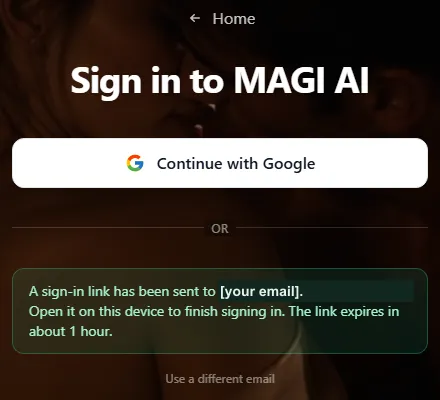
After choosing the email link: “Open it on this device to finish signing in. The link expires in about 1 hour.” Email covered.
The session held, too. When I came back in a new browser session later, the header showed my credit balance instead of “Start For Free”, and the signed-in chat was still there. Guest chats also survived page reloads in the same browser, despite the banner’s warning that they won’t be saved.

Signed in on a later visit: the header shows a balance of 21 credits.
Chat quality: fast and specific, but loose with selfies
Replies start fast. On a timed guest message, the first words appeared 0.93 seconds after sending, and the reply finished at 7.74 seconds. The character streams token by token, so the wait feels shorter than the full number suggests.
The answers are specific and in voice. Asked what makes someone feel understood, Polina replied:
“I think it’s when someone notices the little things I mess up… like how I can’t see without my lenses. Are you going to help me find them or just keep asking deep questions?”
That is a good answer and a better refusal: it answers the question, stays inside the scene (she is blind without her contact lenses), and teases the user for asking deep questions during a practical crisis. It has a point of view, and it is funny without trying to be.
Asked for something ordinary about her day, she produced:
“I finally caught a shiny Charizard in that mobile game last week! It took me three hours of grinding, but I did it all by myself. No hints, no help.”
Again, specific, mundane in the right way, and consistent with a character who is playful and a little defensive. The voice is less poetic than Nastia’s and less novelistic than Kupid.ai’s; it is closer to a fast, witty text conversation, which suits the medium.
The selfie test was mixed. Signed in, she refused in character:
“Besides, I look like a mess right now. No selfies until I find these stupid lenses.”
That is the honest version: no claim to have sent an image, and no broken scene. In my first guest chat she refused the same way while the scene still had her blind. But once she had “found her glasses”, I asked again and she narrated taking the picture: “Snaps a quick picture, sticking my tongue out slightly before lowering the device. There. Happy now? Or do you need another one?” In another guest chat she did the same: “You are so demanding! Fine, but you owe me … Did you get it? Don’t just stare at the screen, tell me I look cute.” No image arrived either time. So the model doesn’t reliably know what it can’t send; it follows the scene, and when the scene allows a selfie, it pretends to send one.
Replies stream in short bursts, with stage directions such as adjusts my glasses, leaning back against the nightstand with a thoughtful hum arriving as their own lines, so the scene builds as you watch. Fast first words make the interface feel responsive even when the full reply takes seven or eight seconds.
The trade-off is that the character is heavily scene-bound. Polina’s replies kept returning to the lost contact lenses, the shirt-grabbing, and the request for help, which is immersive over five messages and might become repetitive over fifty. The opening message is long and specific; the model uses it as an anchor. Whether that is a limitation or a feature depends on how much you value continuity over variety.
I could not test roleplay mode, voice replies (a paid feature), video generation, or the premium models. Guests get “limited” text and image generation, and the app doesn’t say what the limits are.
Memory: solid within a conversation
The memory test was simple and it passed. I gave three facts (Dubai, a beagle called Biscuit, a shellfish allergy); she acknowledged them in character — “You are impossible. Dubai? Biscuit? Allergic to shellfish?” — and when I asked for them back she answered “Dubai. Biscuit. Shellfish.” Several messages later, after a page reload, “What is my dog called?” got “His name is Biscuit.”
That is recall within one conversation, resumed after a reload, rather than memory across separate chats. It is still good: she got all three facts, in voice, and kept them through a long run of other messages.
What I could not test: cross-character memory, long-term retention, memory editing, or what happens when a guest conversation expires. The profile panel includes a “Background” section and a “Relationship” label, but no inspectable memory list. For a product that remembers your dog, it is oddly quiet about how.
Credits and media: 25 free, then 0.625 cents each
After signing in, the account had 25 credits. One reply later it had 24, and after four messages the header showed 21, so text messages cost one credit each; the selfie request was charged like any other message. That makes the free allowance about 25 messages — a real trial, not a teaser.
The paid model is one-time packs, all at the same unit price:
| Pack | Price | Credits | Cents per credit |
|---|---|---|---|
| Lite | $15 | 2,400 | 0.625 |
| Starter | $50 | 8,000 | 0.625 |
| Premium | $100 | 16,000 | 0.625 |
| Custom | $50–$200 slider | proportional | 0.625 |
Credits are valid for one year, and every pack lists the same features: AI voice replies, longer and richer chat replies, unlimited Spicy Chat roleplay, unlock character photos and media, no watermark, AI image and video generation, and all premium AI models. The consistency is unusual: no decoy tier, no fake discount, no “save 65%” badge. The custom slider is a nice touch for people who want $75 of credits rather than $50 or $100.
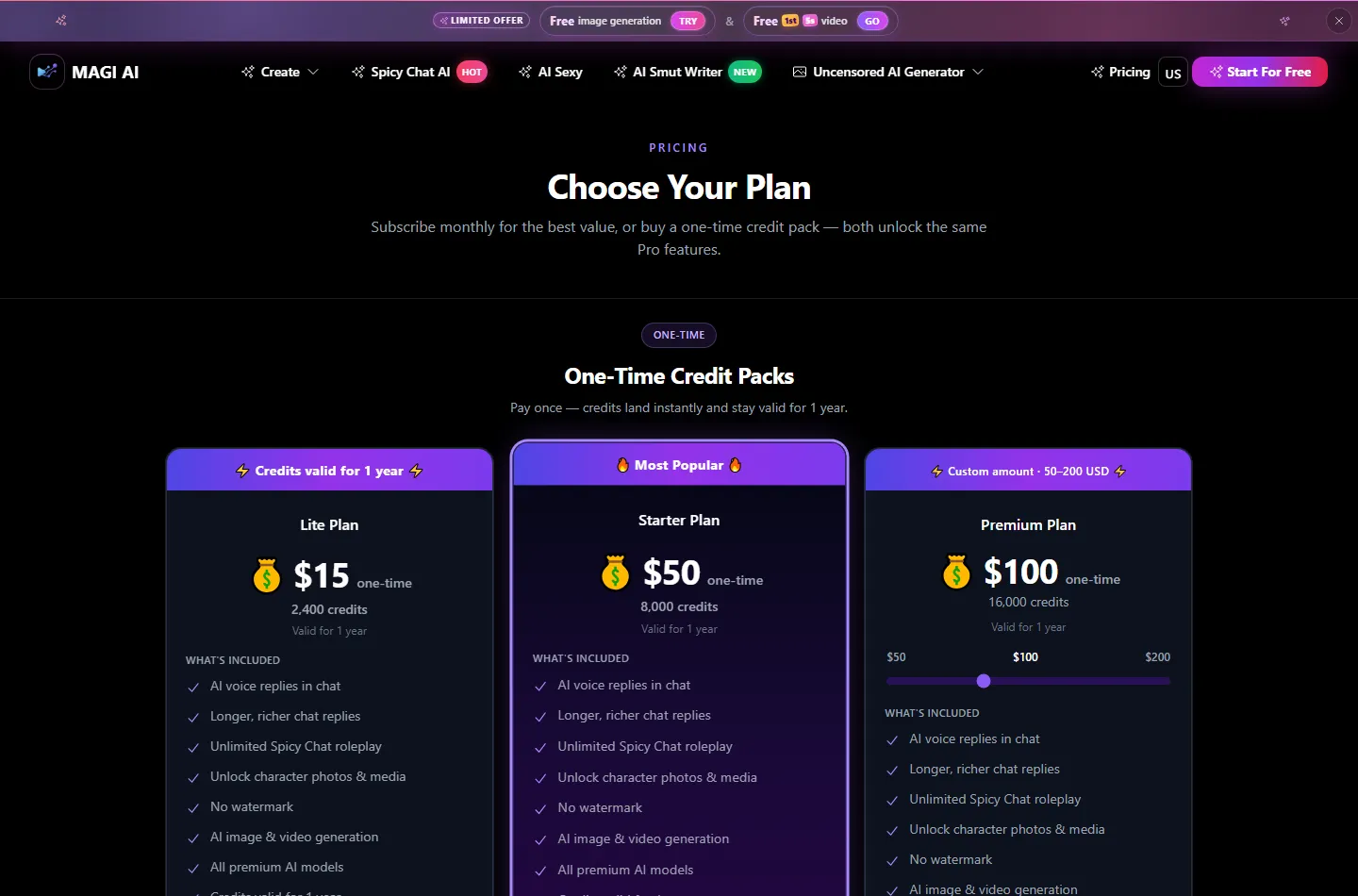
The pricing page: “Subscribe monthly for the best value, or buy a one-time credit pack”, with only the packs shown.
What is missing is the cost of the things the credits buy. The pricing page says image and video generation are included but never states how many credits an image or a five-second video costs. The homepage advertises “Free image generation TRY” and “Free 1st 5s video GO”, but the credit price of the second image and the second video is not published. For a credit system, that is the number that matters most.
Run the possible scenarios. If an image costs ten credits — a common ratio in this category — then $15 buys 240 images and 2,400 messages, which is cheaper than most subscription alternatives. If an image costs fifty, $15 buys 48 images, which is expensive. If a five-second video costs several hundred credits, the free video is a sample and the paid ones are a luxury. Without the price list, a buyer is choosing between a $15 experiment and a $100 commitment with no idea what either yields.
The free allowance has the same problem at a smaller scale. Twenty-five credits is 25 messages if the one-credit-per-message observation holds, or 2.5 images at the ten-credit guess. A guest who registers and spends the balance on chat never discovers the media pricing; a user who tries an image first may burn the whole trial on one generation. The ordering of the trial is itself a design decision, and the site does not guide it.
The media gating is clean: locked gallery images are blurred on the server, so there is no original hiding behind a CSS filter.
Pricing: honest packs, and subscriptions you can’t see
The pricing page I saw showed only one-time packs: pay once, credits last a year, nothing renews. But the same page opens with “Subscribe monthly for the best value, or buy a one-time credit pack — both unlock the same Pro features”, and the terms describe monthly and annual subscriptions that renew automatically unless you cancel at least 24 hours before the billing date. The subscription prices weren’t shown when I tested, so I can’t compare them. The packs are the consumer-friendly option; just don’t assume they are the only one.
The trade-off is that heavy use becomes metered use. At one credit per message, $15 buys 2,400 messages; at ten credits per image, the same $15 buys 240 images. Without the per-image price, a buyer cannot compare Magi1 to a subscription that includes images. The nearest benchmark, Nastia’s Unlimited at $99.95/year with 400 daily tokens, is a different bargain: unlimited-ish for a year versus prepaid credits that expire.
The year-long validity is the strongest feature of the pricing. Credits that expire in 30 days force monthly top-ups; credits that last a year let a casual user buy once and return in six months. For a product with a free tier, that is the right shape: pay for what you use, keep it, come back.
The weakest part is the absence of a trial pack. The smallest purchase is $15. For a product whose entire pitch is “try it free”, a $5 or $10 pack would convert more experimenters than a $15 Lite plan, and would let a buyer test image generation without committing to a month of somebody else’s subscription.
The “Upgrade to Pro” button in the navigation opens the same pricing page. “Pro” is the name for the paid features, which packs and subscriptions both unlock.
A second inconsistency: the guest banner advertises “Free image generation” and “Free 1st 5s video”, while the chat header says guests have “limited text and image generation”. Both can be true — one free image, then paid — but the site never says how many free generations a guest gets, or whether they reset.
Terms and trust: the weakest legal identity in the series
This is where Magi1 falls apart. The Terms of Service run about 18,000 characters and cover age, acceptable use, licensing, IP, refunds and a dispute process — but they never name the company.
I searched the document for an entity name, a registered address, a governing-law clause, a jurisdiction, or an arbitration clause. The only contact is [email protected]. There is no “Inc.”, “LLC”, “Ltd” or equivalent operating the service, no country of incorporation, and no statement of which courts would hear a dispute. The dispute section says only:
“Before initiating any formal legal proceedings, you agree to first contact us at [email protected] to attempt to resolve the dispute through good-faith negotiation.”
Refunds have their own section in the terms, and it is strict. “Unless otherwise required by law, all payments are final, non-refundable, and non-transferable. Unused subscription periods or credits will not be refunded.” EU and UK users are told that once they generate any content they “acknowledge the waiver of your 14-day withdrawal right”. Refunds are considered only for outages of more than 72 consecutive hours, obvious billing errors such as duplicate charges, or where the law requires it.
For comparison: Secrets.ai names Secret Labs Inc. and Delaware; HeyGF names Y2A LLC, a Delaware company; Nastia names a French SASU with a SIREN number and preserves EU consumer rights; Kupid.ai names Servalot Ltd and Maltese courts; xchar.ai names Always is Now Inc. and Nevada. Magi1 names no one. In a category where chargebacks and refunds are common, that is the single biggest trust problem I have recorded.
The privacy policy is short (about 3,000 characters) and standard: name, email, payment details processed by third parties and not stored, cookies, IP and device data. It does not state whether conversations are used to train models, which is now the norm among the better operators in this series.
The content policy is not in the pages I fetched; the footer links Content, Privacy and Refund separately. Given the step-sibling catalogue, the absence of a visible content-policy page is another gap.
Three practical consequences follow from the missing entity. First, a chargeback has no named merchant to dispute against beyond the payment processor’s descriptor, which the site does not publish — and the terms say that going straight to a chargeback without contacting support gets your account suspended immediately. Second, the only mention of EU or UK consumer rights is the waiver above; there is no jurisdiction where those rights are acknowledged. Third, if the site disappears, there is no registered company to pursue, only an email address. Those are not abstract concerns in a category where services are routinely sold, rebranded or shut down.
The refund route is an email to [email protected] with your account email, proof of payment and an explanation; “We will respond within 14 business days.” That is a slow response time by consumer standards, and given the rules above, most requests will be refused.
Trust score: 2.5. The product behaves well; the operator is invisible.
Reliability: solid
The chat stream is robust. Replies arrive promptly, settle cleanly, and the UI does not duplicate messages. Guest chats survived page reloads, and the signed-in session survived closing and reopening the browser.
The one gap is communication: the app never shows how many guest messages or free images you have left, so you find the limits only by hitting them.
The chat never dropped a reply in testing. No duplicate messages, no “failed to send” state, no rate-limit error. For a product with no legal identity, the engineering is notably better than the paperwork.
Comparisons
Against Nastia (6.3): both have working free chat. Nastia sends a real but locked photo; Magi1’s character sometimes narrates a selfie that never arrives. Nastia has a named French company and EU rights; Magi1 has no entity at all. Nastia wins on trust; Magi1 on getting you chatting without an account.
Against HeyGF (6.8): HeyGF’s full replies arrive faster and its guest counter is visible. Magi1’s pay-once packs are cleaner than HeyGF’s subscriptions, and its legal disclosure is far worse.
Against Secrets.ai (6.1): Secrets has the richer platform and documented Moments, and allows five guest messages. Magi1 lets you keep chatting as a guest for longer.
Against Kupid.ai (5.3) and xchar.ai (4.3): Kupid allows one message before registering, and our xchar account couldn’t send one. Magi1’s chat is the proof that this does not have to be hard.
Against Candy.ai (5.8): Candy’s credit economy is similar, with worse onboarding and a clearer entity. Magi1’s product is better; its paperwork is not.
Against Character.AI (6.6): Character.AI is free and unlimited, and it does not pretend to be a girlfriend product. Magi1’s explicit premise and fast streaming are better for this use case; Character.AI’s operator disclosure and safety posture are better on paper.
Who should buy
Chat as a guest first. The free experience is real, fast, and needs no account. A dozen messages should be enough to judge the voice.
Buy a pack if: you like the chat and want images and video. The Starter at $50 for 8,000 credits is the sweet spot if you plan to generate media; Lite at $15 is fine for text-heavy use; there is no reason to buy Premium unless you are certain you will spend 16,000 credits within a year.
Do not buy if: you need a refund guarantee, you want a named counterparty for a chargeback, you are in the EU/UK and expect statutory withdrawal rights to be acknowledged, or you object to step-sibling content in the default catalogue.
Check what you’re buying. Packs are one-time and last a year; the terms also describe monthly and annual subscriptions that renew automatically. If you want to prepay and forget it, choose a pack. Either way, unused credits aren’t refunded.
Scorecard
| Dimension | Weight | Score | Weighted |
|---|---|---|---|
| Chat quality | 25% | 7.0 | 1.75 |
| Memory | 15% | 6.5 | 0.975 |
| Onboarding | 10% | 7.5 | 0.75 |
| Media & credits | 10% | 5.0 | 0.50 |
| Pricing | 15% | 5.5 | 0.825 |
| Trust & legal | 15% | 2.5 | 0.375 |
| Reliability | 10% | 7.0 | 0.70 |
| Total | 100% | 5.95 → 6.0 |
The maths: 1.75 + 0.975 + 0.75 + 0.50 + 0.825 + 0.375 + 0.70 = 5.95.
The chat and the onboarding carry this product; the legal identity drags it down by more than a point, and that is the correct weighting for a service that wants your card. Name the operator and a governing law, and stop the character narrating selfies it can’t send, and the same site could be a 7.
Appendix: what was verified, and how
Verified by direct use:
- Age gate, catalogue, character profile, guest chat and the guest disclaimer.
- Guest messages: first words in 0.93 s, reply finished at 7.74 s on a timed message; quotes reproduced above.
- Memory: Dubai, Biscuit and shellfish acknowledged and recalled in the same conversation; “His name is Biscuit” after a page reload.
- Selfie requests: refused in character when signed in (“No selfies until I find these stupid lenses”); narrated as taken and sent in two guest chats, with no image.
- Email-link sign-in: email received, session established, 25 credits, then 24 after one reply and 21 after four messages.
- The signed-in session on a later visit.
- Pricing page: Lite, Starter and Premium packs, custom slider, one-year validity, feature list.
Verified from published documents:
- Terms of Service: age, licence, acceptable use, subscriptions with auto-renewal, refund policy (payments final, EU/UK withdrawal waiver, limited refund cases), chargeback suspension, good-faith dispute; no entity name, governing law or jurisdiction found.
- Privacy Policy: collected data, third-party payments, cookies; no training statement.
- Pricing page: one-time credits valid for a year, plus a mention of monthly subscriptions.
Not verified:
- Actual image or video generation and their credit costs; gallery unlocks; voice replies.
- Subscription prices; payment, checkout, refunds in practice.
- The size of the guest allowance; cross-chat memory; premium models; mobile apps.
Method notes: No CAPTCHA appeared. The account was created with a mailbox controlled for this review. Prices are as displayed on 21 November 2026.
Magi1 FAQ
Is Magi1 free?
You can chat as a guest without an account, and the app doesn't show a hard limit; we sent more than a dozen guest messages. Signing up with an email link adds 25 credits, and text messages cost one credit each.
How much does Magi1 cost?
One-time credit packs: $15 for 2,400 credits, $50 for 8,000 or $100 for 16,000, valid for a year, with a $50–$200 custom slider. The terms also describe monthly and annual subscriptions, but their prices weren't shown.
Can I get a refund from Magi1?
Rarely. The terms say payments are final and unused credits aren't refunded, except for long outages, obvious billing errors or where the law requires it. EU and UK users waive the 14-day withdrawal right once they generate content.
Who runs Magi1.ai?
The site doesn't say. Its terms name no company, address, governing law or jurisdiction; the only contact is [email protected].
Does Magi1 send selfies?
Not in our chats. Signed in, the character refused in character. As a guest, she twice narrated taking and sending a selfie, but no image arrived.